Showing posts with label Cleveland Museum of Art. Show all posts

Thursday, October 24, 2013

The Cleveland Museum of Art: A mess is spilling over

Ok, so I don't know that I have much to add to the "discussion" on the topic but I do need to vent a bit, especially with the 'facts' as they seem to be unfolding.

From the rather abrupt resignation of the museum's former director for "personal" reasons it was clear something was up, and it was disingenuous of the museum board to even half-heartedly attempt to cover it up. In fact, knowing some of the players in the story something didn't really feel "right" starting near the end of March and certainly after the unfortunate demise of one of the key players in this unfolding saga.

I am more than a bit, erm, pissed at the moment. Of the three Directors of the Cleveland Museum of Art that I've known since moving to Cleveland, David Franklin was the first that I respected -- and the first that I sense respected all patrons more or less equally. Of course, that respect has evaporated.

Timothy Rub was, during the tenure that coincided with my living in Cleveland was uninspiring and not particularly charismatic in my experience -- at museum events I definitely got the sense that he wasn't interested in acknowledging, much less talking to a patron unless he or she brought a significant amount of money to the table. He seemed absolutely ambivalent about engagement, particularly engagement in "my" demographic. I was not sad to see him leave for Philadelphia.

Deborah Gribbon, as interim director following Tim Rub's departure likewise didn't really inspire -- but as an interim director, staying the course and not making any radical departures from the norm during their term is expected -- in effect, serving as a trustee for the next director.

David Franklin, however, was very approachable and engaging including helping to champion both research and writing among curatorial staff and a number of innovative projects like Gallery One and Column and Stripe -- an organization working on engagement for 'my' demographic and brought to fruition in no small part through the efforts of the other key player in this drama.

When the resignation was announced, thus, I was disappointed -- we finally had a director that I wanted to see stick around for a while, and while I had my suspicions that something was amiss, I couldn't imagine it was this significant.

So I hope that the next director will share many of the same positive qualities that I perceived of Mr. Franklin while having much better discretion. Though it seems many are eager to blame the underlying relationship issue entirely on the man, it takes two to tango. Enough said.

What has me even more pissed off is how incredibly poorly (and dare I say unethically) The Plain Dealer has handled this story -- failing to disclose the conflict of interest posed by having their publisher on the board in the original story, naming the (deceased) other party to the "scandal", and dragging her family into it without adding any value to the story, and just plain idiotic soundbytes from the museum's board. Add to that, the way some museum staff have been approached for comment strikes me as just a little creepy. It's like reading a mashup of the worst parts of Fox News and MSNBC combined.

Anyway... I hope that the museum's search for a new director yields an engaging, passionate, individual quickly who can see the museum through it's impending centennial and ensure the museum's reputation as a world-class center for art and research is restored and strengthened. I am eager to see the museum put this unfortunate episode (or rather mini-series) behind it.

Lincoln
(Revised October 25th to add clarity)

Wednesday, September 25, 2013

Column and Stripe Tour of the Cleveland Museum of Art Conservation Lab (@clevelandart)

Mr. Knutas with Van Gogh's The Road Menders,
prepared for loan, in the Paintings Lab
This evening Rachel I had the pleasure of attending a tour and talk by Per Knutas, Chief Conservator of the Cleveland Museum of Art, as part of a program hosted by Column and Stripe, the Cleveland Museum of Art's affiliate group for young friends.

I've found conservation fascinating both for the ethical and technical challenges and questions posed -- and Rachel has conservation work experience (including, most impressively to me reconstructing the shell of an ostrich egg from over 100 individual pieces while living in Italy) so there was no doubt we would attend this evening's program. I was particularly interested because while Rachel has volunteered in the labs the only part of the tightly-secured conservation suite I've see is the classroom and I'm always up for a behind-closed-doors tour.

Illustrating the level of documentation
that may be associated with the
conservation of a single work.
Per, a relatively new addition to the Cleveland Museum of Art staff, started the evening in the Conservation classroom with an overview of both the profession in general and Conservation at the Cleveland Museum of art, including the ethical considerations such as that everything a conservator does must be documented and reversible. I found it interesting to hear that different considerations apply between "modern" works, where a greater level intervention and consultation with the artist is permitted, versus historical pieces where a very conservative approach is taken.

The Rembrandt amongst the conservator's tools
(Click for a larger version)
Delving further into the inner sanctum -- and uncharted territory for myself and most of the attendees -- lab doors were opened and the covers were literally lifted off of works in the process of being conserved by the museum's staff of science-driven artisans. Take, for example, a Rembrandt undergoing cleaning and conservation by paintings conservator Dean Yoder. A think layer of varnish was laid over the work to isolate the "original" paint from the conservation work, and further paints that fluoresce under ultraviolet light are used for the necessary in painting to make the work done immediately apparent to future scholars and conservators.

Demonstrating the UV Light,
highlighting in painting
The careful treatment of works does not stop there, but also careful consideration of cultural traditions. For example, Mr. Knutas related that in considering critical preservation work on a document with religious significance where the culture forbids disturbing living things. To respect that culture, no animal glues can be used -- no brushes with animal hair can be used. The suggestions that it would be proper not to wear leather belts or shoes while working on the piece and that the conservators involved not eat meat the day before are being considered. I knew conservation was a hyper-detail oriented craft, but I had never considered how cultural concerns could so dramatically affect the execution of conservation -- and the lengths the Cleveland Museum of Art is willing to go to respect those traditions.

 Further, in that regard, the Asian Paintings Lab, staffed by conservator Sara Ribbans, is one of only four in United States museums. Ms. Ribbans was trained in the Japanese tradition, and carries that on in Cleveland. The lab has a distinctly different feel than the other labs we visited, including low tables and Tatami mats -- the tools used, likewise, are the same those that have been used by Japanese artisans for centuries.

Rachel pondering frames
As the tour concluded and we made our way back to the classroom where the talk began, we once again passed through a long hallway lined, floor to ceiling, with empty frames. No, this isn't the secret frame shop in the museum, instead, it's storage for the frames that belong to pieces undergoing conservation. A sort of waiting room in the art hospital, if you will, where frames patiently wait to be reunited with their loved ones.

In any event it's quite an unexpectedly dramatic scene.

Oh, and another tidbit: There are more than 45,000 objects in the Cleveland Museum of Art's collection. Less than 2% are on view at any one time.

For more information about Column and Stripe, or to join, visit http://www.columnandstripe.org/

Lincoln

Sunday, June 23, 2013

Cleveland Museum of Art: (My Last) Solstice

Yesterday was an interesting day -- starting in Minneapolis where my original flight was delayed to the point where I literally had a United Airlines employee running with me through the airport to a new gate, where I was then dragged down the jetway for a new flight just before departure and told to take any available seat so that I wouldn't miss my onward connection to Cleveland from Chicago. I'm very thankful for that agent.

In Chicago our flight to Cleveland was delayed because, according to the captain's announcement -- I kid you not, "The airplane was plugged in to electrical power and the outlet broke when they unplugged it".

I made it to Cleveland collected my bag and went speeding towards Solstice at the Cleveland Museum of Art.

While I was not in the best shape when I made it to Solstice I was looking forward to it, hoping that some lessons had been learned from last year. I've attended each of the Solstice Parties since the first one in 2009.

The 2009 party was fantastic; the 2010 party was even better, 2011 was about as good as the previous years. 2012 was lousy. 2013 will be my last. Rather than boring you with a list, I can point you to the post from 2012 and say that it was about the same.

Primary objection holds true -- there was essentially no discernible "art" component to this years festival -- even less so than last year as neither Rachel nor I could find a photobooth much less any of the various art activities that had been staples of pervious years. Performing artists (aside from a few balloon creations) were noticeably missing.

But what made 2013 worse than previous years was the sheer level of noise. The volume in the atrium was so high that you couldn't carry on a conversation with friends 6 inches away -- and if you tried to find solace (or just peruse the art) in the new North galleries -- you would be blown away each time someone had the misfortune of passing by the motion activated doors.

It also seemed this year that the number of obnoxiously drunk people was through the roof. While alcohol has always been fairly free flowing, and there are usually very "happy" people, it seemed like more people were drinking to excess

The result continues to feel not like an event highlighting, or even supporting, the Cleveland Museum of Art, but rather a completely unrelated music event that just so happens to be taking place at the Cleveland Museum of Art.

Based on my later arrival, rather than dealing with parking I had valeted my car at Tudor Arms Hotel (a DoubleTree by Hilton property on Carnegie at MLK I've been curious about since it opened about a year ago) and at the end of the night Rachel and I walked back over and enjoyed an "in town" vacation and a leisurely start to a Sunday. That part was at least enjoyable.

Solstice, however, just wasn't enjoyable. At all.

Lincoln

Tuesday, May 21, 2013

Cleveland Museum of Art: Art Crawl II

Almost exactly two years ago, the Cleveland Museum of Art hosted it's first Art Crawl -- still one of the most interesting events I've attended.

Tonight, Art Crawl Mark II was hosted after hours at the Cleveland Museum of Art. Though the Museum closed at 5:00, the doors reopened at 6:00 for eighty invited guests at the Circles donor levels and above. Divided into intimate groups of about twenty, we had four stops, each lead by a curator or conservator and paired with creative h'dourves and wine.

All four stops were wonderful and really demonstrated both  the passion and personality of CMA's staff. While it's easy to be intimidated by the academic aspects of art but the passion and enthusiasim is contageous.

Stop 1, Reto Thuring, Associate Curator of Contemporary Art with Janet Cardiff's Forty Part Motet

Until a couple weeks ago I can say I honestly had no idea who Janet Cardiff was -- until I got stuck at O'Hare with her when United decided to let our flight to Cleveland leave despite knowing our (different) arriving flights were only slightly delayed and arriving at the gate while the aircraft was still there. (No I'm not bitter, United).  Hearing the artist describe her work I wasn't sure what to expect, and to be honest based on other AV installations I was a little skeptical. Before tonight I had not experienced the work.

Reto provided some background on the artist and the work standing outside the 1916 building in the Atrium -- while occasionally the parting doors would let gasps of choral voices escape. Introduction complete we entered the 1916 building to a chorus of voices -- and the combination of voices and the imagery of the art displayed in the gallery was a powerful, almost religious experience much as if walking into an active cathedral. If you find the right pace in the room it is as if you are in the middle of a choir.

I highly recommend visiting the work (in a 1916-building level 2 gallery) before it disappears in early June.

Stop 2, Sona Rhie Quintanilla, Curator of Indian and Southeast Asian Art with the late 1400s Mandala of Vajradakini

Another relatively new curator to the Museum, Ms. Quintanilla provided  great insight into the Mandala of Vajradakini, currently in Gallery One's focus area just off the main entrance to the museum. Extending beond the surface artistic elements of the work I thought the discussion on Tantra, Yoga reincarnation and Enlightenment -- to be very enlightening (pun not intended).

Stop 3, Louise W. Mackie, Curator of Textiles & Islamic Art with Afruz Amighi's His Lantern.

A piece that I've walked by several times since the Islamic galleries opened and thought was interesting, Ms. Mackie's explanation of the piece -- a hanging woven polyethylene piece with projected light creating shadows -- brought an entirely new level of understanding to the piece and the artist. Connecting the symbols in the art to classic counterparts, such as a nearby prayer niche as well as subtle but more modern political statement -- keys echoing those worn in a war brought new understandings to the piece. Ms. Mackie's enthusiasm for the piece and her description of meeting the artist and artist's execution (hand cut with a hot metal knife) was also infectious.

Stop 4, Moyna Stanton, Conservator of Paper with Antonio del Pollaiuolo's Battle of the Nudes

The last stop was certainly not least -- and I'm not only saying that because paper conservation is an area of particular interest for Rachel -- Ms. Stanton's wonderfully in depth look at the history of Battle of the Nudes was a crash course in print making, differences between "states" in prints, the technique Antonio del Pollaiuolo's work, and the history of repairs to the piece and what has been filled in.

Like a good television drama she was really getting rolling and while I was on the edge of my seat (looking forward to hearing more about the work, particularly the photomechnical infill in one corner) the time was up and we had to move on.

The evening concluded with a light reception and quick remarks from museum director David Franklin, a nice way to wind down and chat with other patrons.

I can't wait for the next one -- and I really hope it will be less than two years this time.

Lincoln

Saturday, March 9, 2013

Column and Stripe/NYC - The Armory Show [Cleveland Museum of Art]

As many regular readers (or those who pay attention to the "Disclosures" bar off to the right [your other right]) know, I'm involved in Column and Stripe: The New Friends of the Cleveland Museum of Art. Unfortunately travel demands of my real job haven't been conducive to attending all of the great events that our Programming Committee organizes.

Exterior of Pier 92 from Across 12 Ave.
Thanks to a last minute change in schedules for one of my big projects, and a United Fare Sale that made Cleveland to New York a $161 round drip flight (and cashing in some of my Hilton HHonors points for a few nights in one of my favorite hotels -- the Hilton Times Square) I was able to join a group of Column and Stripers 400 miles from home at New York City's Armory Show.

C&S Attendees; Mark Cole center background.
Mark Cole, Cleveland Museum of Art's Associate Curator of American Painting and Sculpture (until 1960) was in New York as well and graciously guided us through Pier 92's Modern Art.

Mr. Cole not only introduced us to some of the dealers who he knows, but also pointed out artists with Cleveland connections and artists who he thinks are significant and would like to see added to the museum's collection to complete the story (he remained mum as to specific works).

After our overview fly-by the group splintered and attacked the show in greater detail. The show which brings together leading art dealers from around the globe and concentrates them on two of the piers of Manhattan's West Side is a little overwhelming. ("Modern" is on pier 92, "Contemporary" is on pier 94)

One aisle of dealers at Pier 94
Although the show is made up of dealers (after all, unlike a museum, the goal here is to sell art), it is curated -- the dealers have to present a proposal months in advance, and from what I understand the cost of exhibiting can push into the high five-figures, so the quality of art is very high across the board. So are the prices -- many, though not all, of the exhibitors have prices listed on the label accompanying each piece, with prices I noticed ranging from about $2,500 to upwards of $370,000 and spanning from the technically simple to the obscenely complex.

It was a wonderful opportunity to enjoy art outside of Cleveland with similarly interested young Clevelanders, and hopefully this will be the first of many trips -- and that Rachel's work schedule will allow her to join in the next trip.

[By the way, any of the pictures should be clickable for a larger version if you so desire]

Lincoln

Tuesday, October 9, 2012

Column and Stripe: Transformer Station Hard Hat Tour (@ClevelandArt #ColumnAndStripe)

I'm a sucker for a construction site -- I'm see a lot of interesting sites through my day job (a hard hat and a reflective safety vest are perpetually in my trunk) but some of the sites I find most interesting are a little bit trickier to access -- the Cleveland Museum of Art's new gallery space (I am forever tempted to sneak around the barrier and go for a look-see) being one example. [Rachel and I did sneak in for the Atrium preview which was an amazing opportunity to peek in].


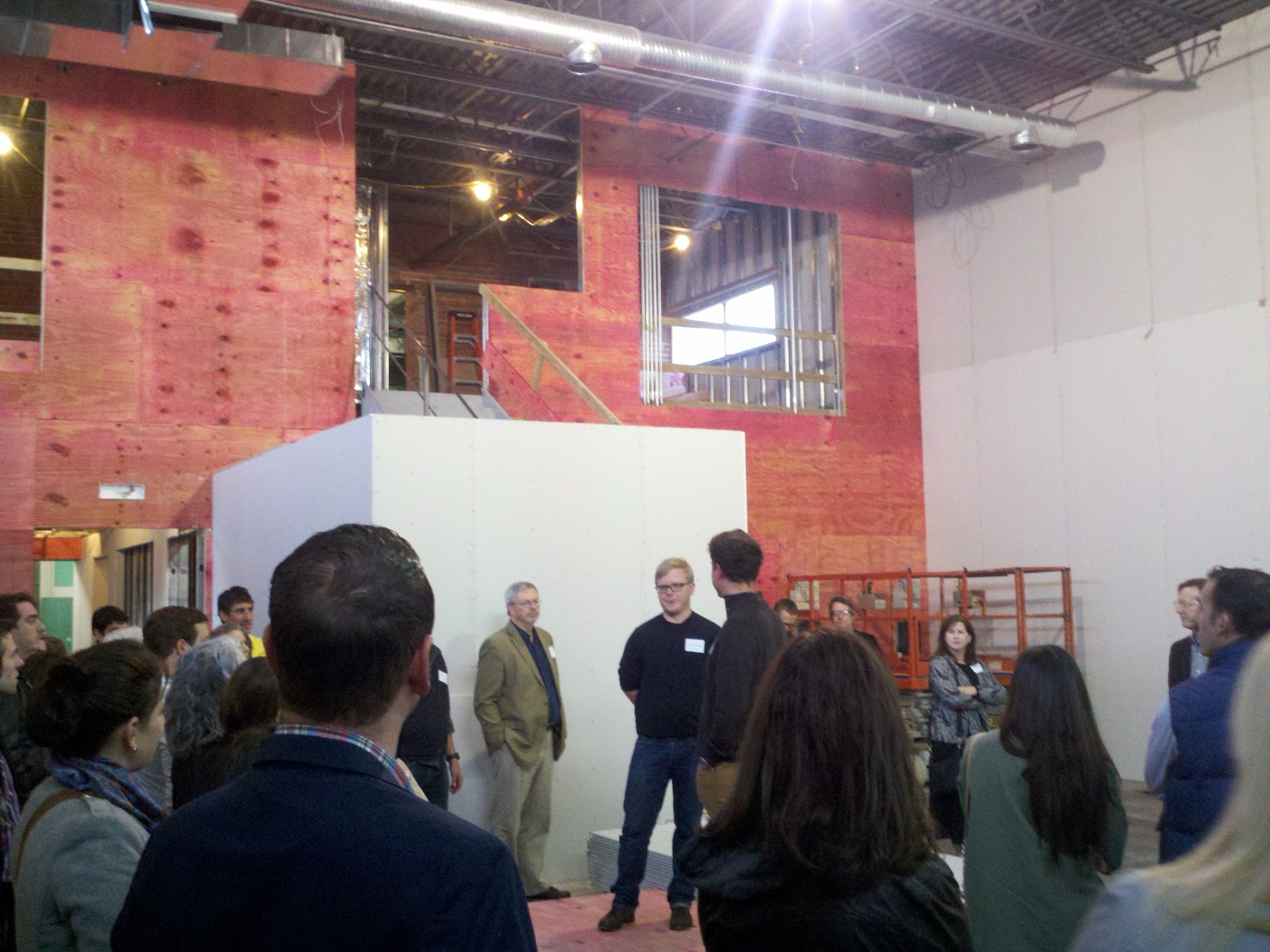
The Transformer Station, on West 29th Street on Cleveland's West Side is an interesting collaboration between the Fred and Laura Ruth Bidwell Foundation and The Cleveland Museum of Art, with each organization programming the space for six months out of the year. Tonight, the Bidwells and their Architect invited Column and Stripe and AIA Cleveland members for a presentation on the project and to tour the space well before it's February 1, 2013 public opening.
 
Once the formal presentation had ended the assembled guests were free to roam throughout the building and peek into, over, and under every nook and cranny of the space -- from an old tunnel that one presumes brought the conductors  powering Cleveland's street cars in and out of the building and glass insulators on the ceiling in the historic original building to the elevator shaft and gallery space in the new addition (oh and the 15-ton capacity overhead crane in the original building definitely makes a unique statement in the appropriately named crane gallery.
 
After the nooks and crannies had been thoroughly explored, Column and Stripe's president Graham Veysey hosted the attendees in his hip pad across the street at the Ohio City Firehouse with an assortment of beer, appetizers, conversation, and food courtesy of Touch Supper Club's food truck.


Lincoln
(Full disclosure: I serve as the chair for Column and Stripe's Philanthropy Committee)

Wednesday, October 3, 2012

Cleveland Museum of Art: Concert in the Galleries (with Cleveland Institute of Music students)

Kodaly: Sonata for Solo Cello, op. 8 (Mvt. III)¹
Piazzolla: Tango Etude No. 3²
Grgin: Cappriccio for solo clarinet 3²
Kovacs: Hommage a Manuel De Falla²
Molnar: Haru No Umi³,ª
Debussy: Sytinxª
Hoover: Kokopelliª
Mendelssohn: String Quartet in E-flat Major, Op. 44 No. 3 (Mvt. I)º
¹-Matthew Allen, cello; ²-Nikola Djurica, clarinet; ³-Joseph Rebman, harp; ª-Jeiran Hasan, flute; º-Veridian String Quartet (John Heffernan, Deborah Milburn, violin; Catherine Schilling, viola; Genevive Tabby, cello)
In the Reinberger Gallery, Gallery 212, 1916 Building at the Cleveland Museum of Art.

It's already been a loooong week, so while I was somewhat tempted to skip this month's free concert in The Cleveland Museum of Art's galleries and perhaps find a strong margarita. Instead, I met Rachel and her brother in Gallery 212 for bite-sized collection of classical music among classical art.

Since the series debuted last year I've been a fan -- bringing students from neighboring University Circle institutions The Cleveland Institute of Music and Case Western Reserve University into the beautiful galleries of The Cleveland Museum of Art for a collection of relatively short pieces for solo instruments and small ensembles.

Acoustically, Gallery 212 is rather live and rather reverberant (echo-y, if you will) which I think helped to draw out the sounds, particularly in the strings, while not being as complimentary to the woodwinds and occasionally muddying the quartet's otherwise delightful performance.

The program set off to a rousing start with cellist Matthew Allen playing the lively third movement (Allegro molto vivace) of Zoltan Kodaly's Sonata for Solo Cello. Early on the piece caught my ear with layered sounds that reminded me a little bit of a gallop before taking on a more marine feeling.

Nikola Djurica was next up with three pieces for solo clarinet each having very different sounds -- ranging from fluttering and airy in Pizazolla's Tango Etude No. 3 to Grgin's Cappriccio for Solo Clarinet, a piece that seemed to pull in the jazzy, swinging enthusiasm of the roaring 20s tempered with a hint of the depression. Mr. Djurica's final piece was a clarinet homage to Manuel De Falla, and while I picked up a bit of the Spanish sound, I think the room's acoustics diminished the effect.

My favorite piece from the evening was a collaboration between harpist Joseph Rebman (who I've heard perform in a bar as well as a proper recital hall) and flutist Jeiran Hasan, Harau No Umi by composer Josef Molnar which was just several minutes of meditative bliss with a distinctively Japanese sound that reminded me of gently falling water.

Ms. Hasan followed up with two pieces for solo flute -- Debussy's Syrinx  and Hoover's Kokopelli which were enjoyable, but the room acoustics did not flatter the performance.

Last on the program, the Veridian String Quartet preformed the first (allegro vivace) movement from Mendelssohn's String Quartet in E-flat Major, was again warm -- assisted by the room -- and captivating with a hint of sorrow.

After the concert had ended the three of us paid Martin Creed's Half the Air in a Given Space (in the Glass Box gallery through Thanksgiving) a visit -- it was a unique experience, and a separate post on that will be forthcoming.

Lincoln

Monday, September 10, 2012

Column and Stripe: Cleveland Public Art and Architecture Walking tour (@clevelandart #columnandstripe)

On Thursday evening a group of about 30 Column and Stripe members assembled in the plaza separating Progressive Field from The Q downtown.

Our host for the evening was Greg Peckham, Managing Director of LAND Studio and Thomas Starinsky, Associate Director of The Historic Gateway Neighborhood Corporation.

The talk started revealing some unique features of the complex we were standing in, credited as one of the first planned urban sporting complexes in the country. Integrated with the existing neighborhood and with features now taken for granted -- like a sunken playing surface in Progressive Field so that the activity can be seen by passers by outside the park.  Public art in the project is functional (such metal spires near Ontario street conceal ventilation for underground kitchen activities), historical (a planter that incorporates photos, maps, and merchandise from the Central Market that had occupied the site from 1850.

Column and Stripe Members
Outside the Colonial Arcade /
Courtesy Clarissa Westmeyer
Temporarily halted by a passing rainstorm we took shelter under a convenient bridge and learned a little bit more about the mission of both organizations before the skies parted and we pressed on toward the Colonial Arcade -- stopping for a moment to discuss Cleveland's Bike Rack, a new-to-me bicycle parking option for downtown commuters that includes lockers as well as showers and changing facilities for professionals who want to bike to work.

At the Colonial Arcade we had a chance encounter with the Arcade's new developer inviting our ideas for what we'd like to see in the next generation of downtown retail and along with a plug for a Pop-Up Party on September 27th from 5-8pm that sounds very interesting. Although the Colonial had been a stop on a walking tour I took about a year ago, I had never actually been inside the Arcade and was excited about stepping through the doors. It's a bit smaller in scale than The Arcade, but nonetheless an impressive piece of architecture connecting  Euclid Avenue on the North to Prospect on the South.

The Arcade / Courtesy
Clarissa Westmeyer
Continuing with a slight jog on Euclid Avenue there was a brief discussion of the public art elements involved in the Euclid Corridor project (many of them previously discussed in these two posts from the "Take a Hike" walking tours series) before continuing through The Arcade -- an engineering challenge so great for its time that only a bridge builder was willing to take it on, and one of my favorite interior spaces in Cleveland.

Passing through The Arcade we made a slight jog again -- this time on Superior Avenue to visit the Cleveland Public Library's Reading Garden (home to some of my favorite sculptures from Tom Otterness -- whose work I've since stalked in New York and Kansas City among others). The original plan, it turns out, for the Cleveland Public Library's expansion was  for the new building to be attached to the existing facility. For a variety of reasons that generated outrage and the result was two distinct buildings linked by a tunnel running under the reading garden.

Column and Stripers on the roof
at Greenhouse Tavern / Courtesy
Clarissa Westmeyer
With the Cleveland Public  Library closed for the evening we didn't actually enter the garden (or fully experience the LAND-facilitated temporary art installation in the garden) we walked around the perimeter of the garden before concluding the official tour in Mall A, home to Cleveland's Fountain of Eternal Life where the past and future architecture of the Mall Plan buildings was discussed -- from the new (and very contemporary) Medical Mart respecting the vertical rules of the existing classical buildings to the "green roof" of the subterranean Cleveland Convention center.

The evening drew to a fun close with an extended happy hour on the roof of the Greenhouse Tavern on East 4th street with plenty of fun socialization on a beautiful early fall evening.

Also, as a plug, a few of Rachel's wonderful robots (including my CelloBot) are on display as part of the show It's Only A Paper Moon at Proximity Gallery trough October 6.


Lincoln
(Full disclosure: I serve as the chair for Column and Stripe's Philanthropy Committee)

Friday, August 24, 2012

Cleveland Museum of Art: Contemporary and Photography Galleries Open House @ClevelandArt #ColumnAndStripe

Members of Column & Stripe, The New Friends of the Cleveland Museum of Art were invited to join members of the Contemporary Art Society and the Friends of Photography for an open house and reception for the recently reopened Contemporary and Photography galleries and their curators. Since these two are my favorite of the museum's galleries there's no way I'd turn down the invitation.

Before heading up to the galleries we assembled in the Recital Hall on the lower level of the Breuer building for an enlightening introduction.

The Contemporary Art Society introduced new Assistant Curator of Contemporary Art Reto Thuring who illustrated the new arrangement of the contemporary galleries as grounded more in themes and inviting dialogues between pieces rather than the previous, more chronological arrangement. As an aside, the new arrangement of the temporary walls in the galleries leads to a much more open feeling.

Not to be outdone Barbara Tannenbaum introduced the current photography installation DIY: Photographers (through December 20), highlighting digital Print on Demand photo books from a wide swath of photographers, some internationally known professionals and some local high school students. Unlike other areas of the museum where touching art is verboten, this exhibition invites you to pick up and thumb through the 157 photo books that were selected -- from the smallest [I found] being Things Darby Chewed not much larger than a credit card, to the largest, Astronomical a twelve volume set where each page represents one million kilometers in the universe (Yes, there are a lot of black pages).

And perhaps the most exciting news: This coming Tuesday the "Art Detour" from the North Entrance through the museum's basement to the galleries will end as the spectacular Atrium opens to the public for the first time-- I can't wait to see and hear people mingling in Cleveland's new great room.

Lincoln
(Full disclosure: I serve as the chair for Column and Stripe's Philanthropy Committee)

Saturday, July 21, 2012

Cleveland Museum of Art: Column and Stripe Speakeasy/Youth and Beauty (@ClevelandArt)


Members enjoying the Column and Stripe Lounge
 Youth and Beauty: Art of The American Twenties On view now through mid-September at the Cleveland  Museum of Art is an exciting survey of the art American artist produced during the 1920s. I'll freely admit that the first half  of  the 1900s  contains many of  my favorites both in classical music and art, so it should  come  as no surprise that I enjoy this exhibition's look at the decade.

Of course, in a decade best known for prohibition and sandwiched between the end of World War I and the beginning  of the Great Depression has some exciting inspiration. The Cleveland  Museum of  Art seized upon the inspiration of the decade to offer an exciting event tonight, the Youth and Beauty Speakeasy. Column and Stripe: The new friends of the Cleveland Museum of Art roared to life with its first official event, the Column and Stripe Lounge.

The event was a clear success had an energy of excitement -- a je ne sais qouis like the first Solstice, and enhanced by the beautiful atrium. Although the population was primarily in the "young professional" bracket, people of all ages could be seen mingling and comfortably enjoying themselves while the exhibition was open for casual perusal, bars were open, and a DJ was spinning tunes, though conversations were a plenty as attendees found old and new friends alike to chat with.  

Though costumes were not required -- or really even advertised as encouraged -- a number of people, including Rachel and yours truly, were decked out in period-appropriate clothing contributing to a special feeling for the event.

Rachel trying her hand at 1920s Tweeting
A major attraction was an appearance by Dr. Sketchy Cleveland (Anti-Art Studio: Where Drinking and Drawing is the Norm) allowing attendees to try their talents sketching models with slightly risque takes on pieces form the exhibitions.

Outside the exhibition in the Key Bank Lobby attendees could experiment with a classic typewriter and paper scroll in "1920s Tweeting"

All-in-all it was a great social event at the museum and it was fantastic to see so many younger Clevelanders enjoying a Friday evening at the Cleveland Museum of Art -- and although the crowd had started to thin slightly as the clock ticked away the evening, there was still a good sized assortment of attendees when the museum closed at 9 PM.

Column and Stripe Members enjoying L'Albatros

But for Column and Stripe members the party didn't end -- The nice folks at L'Albatros hosted us for drinks and a late-night happy hour menu.

As members filtered in we took any available corner of the main bar and outdoor patio bar; as we reached critical mass a lovely back room became our speakeasy and rounded out the evening.

Due to impending travel tomorrow morning I had to excuse myself after finishing off a glass of wine but the event was still going strong.

Join us for the next Column and Stripe event -- for more information see http://www.columnandstripe.org/.

Lincoln

Sunday, July 1, 2012

Cleveland Museum of Art: Summer Solstice 2012

The Cleveland Museum of Art's  Summer Solstice is the hottest party of the year. Now in the fouth year it is perhaps the most inclusive as well with people ranging in age from late teens to earily centenarians and clothing ranging from T-shirts and jeans to the height of formal wear.

Unfourtunately, this year didn't have the same level of excitement and verve as the last three, and almost had the freeling that the event had gone coroprate. The first two Solstices were clear celebrations: The first celebrating the opening of the East Wing galleries,  the second celebrating the opening of gelleries in the lower level 1916 Building. The 2011 Solstice didn't have a clear celebratory focus but was nontheless a fun celebration of art with artists performing and working the crowd creating a cool energy, and light food scattered around. I didn't get that fun vibe from tonight's solstice -- the only food was by way of food trucks, I don't recall seeing any artists on the museum's grounds. Nor were there other activities, such as the variations on a "scavenger hunt" theme that provided a interesting way to occupy time for Solstices 2 and 3.

For the first time my expectations were not met, and not met by a large margin. It seems like the singular focus of this solstice was music, and that just doesn't captivate me without some visual connection.

That's not to say that it wasn't enjoyable, it just wasn't as enjoyable as the first three. Rachel and I scoped out the grounds and chateed with coworkers and friends spanning a good 40 years in age. The highlight, for me, of the evening was seeing the atrium now that the "shed" enclosing the escalators in the East Wing and protecting visitors from the atrium construction has been removed, for the first time allowing a view of the full atrium.

The Youth and Beauty exhibition, which officially opens tomorrow and celebrates art of the 1920s was also quite attractive, and a period I particularly like. It was interesting -- if slightly irreverant -- to tour the exhibition with a group of four friends all in varying degrees of "slightly buzed" and attempting to interpert both artists motives and models expressions. I know this is an exhibition that I'll be visiting frequently through it's run.

And of course, tonight's Solstice was the long-awaited official launch of Column and Stripe, the new friends of the Cleveland Museum of Art. At about 11:30 we took over the walls of the 1916 for a short but very cool video piece (I'm told it will be posted on the http://www.columnandstripe.org/ website on Monday

The party contined late into the morning, but with Rachel's feet killing her and mine threatening suicide, after 5 hours we bid adieu to our friends and headed for home.

It seems that Solstice has unfourtunately evolved from a multi-dimensional art-and-museum celebration into an event with a singular focus on music and a side of "see and be seen", which is sad and particularly baffling in the context of the Cleveland Museum of Art. While in previous years the event has tied into the museum's collections and galleries and provided inspiration for the kind of excitement art can foster, this year's Solstice seemingly had no tie-ins whatsoever; it might as well have been at an annonymous fairgrounds; I'm not sure anyone would have noticed the difference. And they probably would have served Red wines.

Lincoln

Saturday, May 12, 2012

Announcing Column & Stripe @ClevelandArt (with Solstice Ticket Offer)

One of the few areas where I've felt that the Cleveland Museum of Art was lacking was that there was no organization for young professionals, or rather events didn't seem geared to young professionals needs and scheduling.

I'm happy to report that for the past few months I've been serving on two of the committees (along side a diverse group of other engaged Clevelanders) for what has become Column & Stripe: The New Friends of the Cleveland Museum of Art.

While a lot of specific programming is still being determined, a lot of the possibilities that we're discussing sound really great -- everything behind-the-scenes looks at museum departments [if you know me, you know that's a personal favorite] to walking tours of public art in Cleveland, to social opportunities (with and without curatorial staff).

While social this certainly won't be another happy hour drink-and-hang-out group, and membership will open doors to free and discounted unique programming, in addition to supporting one of Cleveland's cultural gems.

The best part is if you're already a Museum member Column & Stripe is only $50 more for an individual or $75 for two. (If you aren't already a member, the combined Cleveland Museum of Art membership along with Column and Stripe benefits starts at only $100 per year -- that's less than nine bucks a month, and includes unlimited no charge access to the museum's ticketed exhibitions [the permanent collections are always free] as well as access the exclusive Column and Stripe programming we're planning.

And the first 100 people to join Column and Stripe before we officially launch at the museum's Solstice Party on June 30th get a free ticket to Solstice. Already have your Solstice Ticket? Join Column & Stripe at Solstice to save 50% on C&S dues.

For more information see the Column & Stripe page on the Cleveland Museum of Art's website.

Lincoln

Saturday, March 10, 2012

Cleveland Museum of Art: Ensemble Signal: Music of Steve Reich (@ClevelandArt)

Reich: Sextet (1984) (Jamie Dietz, Doug Perkins, Bill Solomon, David Skidmore, David Friend, Lisa Moore)
Reich: Double Sextet (2007) (Courtney Orlando, Olivia DePrato, Lauren Radnofsky, Caitlin Sullivan, Kelli Kathman, Jessica Schmitz, Bill Kalinkos, Ken Thomson, Doug Perkins, David Skidmore, David Friend, Lisa Moore)
Brad Lubman, conductor; Paul Coleman, sound director.

I first consciously heard Steve Reich's music in the form of New York Counterpoint played by Elinor Rufeizen at her Junior Recital at CIM and then again in the Museum's Contemporary Galleries. This year marks Steve Reich's 75th birthday and over that period of time his music and from of minimalism have snuck into culture through film and other avenues.

Sextet, from 1984 the first piece on tonight's program, was heavily percussive and shared many of the same textures and feelings of New York Counterpoint, and like that piece I loved the vibrant feeling of the energy of an urban landscape that evolves. While sometimes ambiguous (in the program note the composer observes "In music which uses a great deal of repetition, I believe it is precisely these kinds of ambiguities that give vitality and life") the overlapping sounds and constant motion gave a nicely drifting focus from instrument to instrument. Pushing forward it was interesting to hear as impulses from the vibraphone had effects of rippling through the pattern established by the other instruments, like a drop of water disturbing the glassy surface of a still lake.

Taking yet a different feeling, the piece earns a slower, more dark and ominous feeling making me think of a dark side street near a happening district at night. That feeling didn't last long with a dramatic shift and punctuated change to brighter sounds that would have been right at home in a busy elevator lobby with cars quickly arriving and departing with the accompanying chimes, transitioning into what I scribbled to myself as a "time clock tango" with the hustle at the end of a shift to punch out and go home -- with the next feeling being unquestionably one of rush hour.

Throughout the piece the insistent, driving, feeling of the percussion was stunning.

After intermission, Double Sextet finished the program. According to the program note it can be performed either by a single sextet playing against a recorded iteration of itself or by two different sextets simultaneously occupying the stage. The use of a single group of musicians playing against is similar to the technique in New York Counterpoint, and is an interesting challenge for the performer. Tonight's performer was the much rarer true double sextet and while I didn't have any clear images formed while listening to the piece it was interesting to hear the relationship between instruments at any given moment and the amazing cohesiveness (Honestly, 12 different musicians playing 6 different instruments, rarely--if ever--playing the same thing, has to be a difficult feat to pull off). Once the initial bright energy faded a more melancholy sound emerged and the sound that hovered over the ensemble made me think of a slowly played accordion.

After the performance it was interesting to hear reactions -- virtually everyone enjoyed the concert, but if you asked someone to pick a favorite the results were nearly perfectly split. 

Lincoln

Wednesday, March 7, 2012

Cleveland Museum of Art Young Professionals (@ClevelandArt)


One corner of the Atrium as viewed from the Boardroom.
A single photo does not do it justice.
Anyone who knows me -- or who has read more than a few installments of this blog -- knows that I'm a passionate supporter of the arts in Cleveland and a relatively young professional.

Heretofore the Cleveland Museum of Art has not had an organization targeting its appeal at the Younger Professional and I have to admit that I've been a bit concerned that the sharp and stately appearance of the Museum's physical presence may unfairly color others impression of the institution. Namely, as something "old" "stuffy" and "academic"; something that as I've become closer to the museum is certainly not true of either the Museum, its staff or current leadership.

In short something should be done to take the sharp edge of the granite exterior to help other young(er) Clevelanders to enjoy and appreciate the gem we have in our back yards.

Luckily I'm not the only one who has felt this way and a group of staff within the museum over the past few months has been quietly reaching out laying the groundwork for such an endeavor, culminating in the first official task force meeting tonight.

Tenatively named RallyMUSE, there are some really exciting ideas in the air and it will be exciting to see what comes out out meetings between  now and when the group officially launches later this summer.

I probably shouldn't say much more -- and perhaps I shhouldn't have said that much -- but while I'm on a roll, it's clear that this endeavor has the enthusiastic support of all levels of museum staff. Likewise the crosssection of individuals in attendance was wonderfully diverse. Through conversations that bubbled across the course of the evening it's clear there are a lot of passionate people inside and outside the museum prepared to invest time and energy to help make this a success
I'm looking  forward to the process and already can't want of the official launch!

Lincoln

Thursday, March 1, 2012

1000+ Visitors plus Cleveland Museum of Art: Bulletin of the Museum 1968-70

February marked a milestone for Lincoln in Cleveland: During the month this blog had more than 1,000 unique visits. While I've been flirting near the thousand mark for the past several months this is the first time I've hit that number. Thanks to everyone who's stopped by to read -- I always welcome comments and suggestions.

Since this week has been quiet (though Rachel and I are thinking about seeing Memphis at PlayhouseSquare Frideay) Below I continue with the series looking that the Cleveland Museum of Art, through old issues of its publication, The Bulletin of the Cleveland Museum of Art. All of the posts in the series, in reverse chronological order, can be found here.


My collection of Bulletins continues with September 1968. The format changed sometime in the 1960s and by the September issue, the bulletin no longer carries a issue or volume number and it is devoid of information about the Museum, instead presenting extensive essays on specific pieces.

This format continues in November 1968 but the back cover announces Design and the City: An Architectural Exhibition at The Cleveland Museum of Art from December 11 to January 12: It sounds interesting, and I wonder if any lasting change came out of it:
"...conceived by the Cleveland Chapter of the American Institute of Architects and brings together the interest of the public and professionals alike in planning for choesive improvement of the Metropolitan Cleveland Area. The ehxibit [...] consists of the efforts of over 60 architects, planners, engineers, and desigeners as well as numerous public officials of the city and the county, the Cleveland Board of Education, Case Western Reserve University, the Greater Cleveland Growth Association, and the Seven County Transportation Study. Interesting physical features of past and present Cleveland are shown together with possible directions for future planning of the city"
December 1968 through February 1969 are also again devoid of institutional infromation, but June 1969 includes the 1968 annual report which is full of gems, some foreshadow the Museum's current expansion and renovation projects. The new Educational Wing, designed by Marcel Bruer, began construction on June 17, 1968:

The curtailment of the Museum's exhibitions and activities -- due to a lack of classrooms or auditoria for the duration of construction -- is in fine focus, as is the work of the Museum's "inhabitants" -- which from the description has probably not changed much in the 43 years since, but in reading
"[68.206] is the Museum's registration number and has also been carefully painted onto the back of the painting by a member of the Registrar's Department. Here at least four cards must have been prepared [...] these are the permanant records by which the Museum mantains its inventory of works in the collection."
I have to assume that these cards (and the "notebook with much additional information gleaned from previous and continual research" maintained by the Paintings Department) have been supplanted by technology, but I'm sure the process is much the same. The introduction, announcing the addition of 365 new works to the collection and pinning completion of the Educational Wing Construction as 1970, continues "We are more certainly justfied than Mr. Micawber in repeating that, "Things will be much improved in the not too distant future" -- as it will be when the current renovation and expansion is concluded.

Although reports of individual departments are interesting, very little jumps out as being strongly relevent after 40 years, though it was interesting to read the Registrar's report noting a collection of 41,287 objects (I haven't been able to locate the 2011 current collectcion size), and Public Relations noting Museum attendance of 435,106, "a reduction attributed in part to inconveniences occasioneed by the construction of the new Education Wing."

The Printing department is proud to announce that a IBM Selectric Composer was installed to facilitate printing of some publications formerly printed outside. Admission to the museum continues to be free -- and Monday remains day off for the Museum's galleries, with normal hours being published as  Tuestday, Thursday, and Friday 10-6, Wednesday 10-10, Saturday 9-5, and Sunday, New Year's Day, and Memorial Day 1-6.

The February 1970 and February 1974 bulletins have little text but serves as an illustrated "Year in Review" for acqusitions from the previous year, and it's interesting to compare acquisitions over time and to see how many of the pieces from both I can recall seeing in the Museum's galleries -- somewhat suprisingly, I recognize more pieces from the 1970 edition.

June 1974 ends this tour through the Museum's history-via-Bulletin with the 1973 annual report. Light on institutional (vis collection) information, Betsey Belkin is noted as joining the Cleveland Museum of Art Library -- today, Ms. Belkin is Ursuline College's Director of Library. Also coming of note from the Library is the note that the circulating collection of the library's photography department has been phased out (with much of the contents donated to the Cleveland Public Library). This change makes the Museum's library for the first time completely non-circulating.

Burried near the end of the report, in the sea of text, "A decision was reached to permanently install The Thinker in its present damaged condition in front of the museum's south entrance. A bracket was designed and manufacturerd to support the sculpture on a new granite pedestal which was imported from Italy." -- it's easy to forget that the well-weathered and slightly deformed statute wasn't always the way we see it today.

Lincoln

Sunday, February 19, 2012

Cleveland Museum of Art: Rembrandt In America Preview Events (@ClevelandArt)

This week the Cleveland Museum of Art opens what may be the most anticipated exhibition in recent memory: Rembrandt in America. With this exhibition the traditional Members Preview Party seems to have been replaced with a series of more focused events.

Members Happy Hour
 Last night Rachel and I found ourselves at the Members' Happy Hour during the Museum's normal Friday evening operating hours and featuring DJ Reena Samaan with a cash bar and a diverse collection of attendees and the energy and buzz in the space was on par with that of the Summer Solstice.

Last night we did a quick survey of the exhibition and engaged in extensive socializing.

Tonight Rachel and I returned to the museum for the Supporting Circles Reception after-hours and the seeming successor in interest to the Members Reception and Preview Party -- an event attracting a distinctly older group and generally lower key gathering.

The event tonight began with welcoming remarks from David Franklin, the museum's gregarious director and the most captivating and compelling introduction to and overview of an exhibition I can recall presented by Jon Seydl, Curator of European Painting and Sculpture 1500-1800.

The exhibition covers the full span of Rembrandt's career spanning a universe of attributions -- randing from unquestionably Rembrandt (including a number of self portraits) to those originally attributed to Rembrandt where the true source -- and amount of Rembrandt's involvement, if any, is now in doubt.

While Rembrandt's work is visually gripping on its own with intriguing light and detail the exhibition presents works of questioned and unquestioned attribution in close proximity allowing the viewer to visually compare them and draw their own conclusions. In another gallery, paintings that are obviously the same subject -- one by the hand of Rembrandt, the other by a student -- lets the viewer truly understand the difference and mastery: One is softly lit but has crisp, almost life-like details while the other the focus is just a bit too soft -- almost if the camera's lens was a hair out of focus -- and the shapes are quite a bit  less photorealistic.

The exhibition also features an interactive exhibit with one the pieces in The Cleveland Museum of Art's collection that falls squarely into the questionable attribution category and attendees are invited to look at the art under the same conditions as the curators and conservators -- direct light, UV, XRay, Raking light and the like.

Though slightly irreverent, I found that great fun can be had asking and answering "What emotion is that facial expression embodying?"

The one question lingering is "why is the M in Rembrandt backwards and red?"

Rembrandt in America, now through May 16th at the Cleveland Museum of Art, members always see exhibitions free - otherwise $14/adults with student and children discounts. In addition to the ticketed special exhibition, a free companion in the form of Rembrandt Prints from the Morgan Library and Museum in the 1916 Building's Gallery 101

Lincoln

Wednesday, January 4, 2012

Cleveland Museum of Art: Music in the Galleries (@ClevelandArt, @CIM_Edu)

Bach: Selections from Suite No. 2 (Prelude, Courante, Sarabande, Gigue)*
Lebegue: Puer Nobis Nascituri^
Pachelbel: Der Tag Isto so Freudenreich^
Bach: Partita No. 3 for Solo Violin in E major, BVW 1006%
Paganini: Caprices for Solo Violin, Op. 1 No. 23%
Stravinsky: Elegie for Solo Viola&
Reich: New York Counterpoint for Clarinet and Tape+
at the Cleveland Museum of Art in Contemporary Art Gallery 225, East Wing

*-Annalisa Boerner, viola; ^-Paula Maust, organ; %-Boson Mo, violin; &-Ji Young Nam, viola; +-Elinor Rufeizen, clarinet

The holiday season is over and I'm back at the office -- while everyone recovers from their festivities, the beginning of January is always a bit quiet on the performing arts front. The Cleveland Museum of Art, however, is pressing along uninterrupted with the series of monthly concerts in the galleries featuring performances of Cleveland Institute of Music students.

While previous performances have been in the 1916 Building's galleries, tonight's concert moved to one of the Contemporary galleries and continued a trend of increasing attendance. The next concert, by the way is Wednesday, February 1st at 6:00 -- perhaps a fine prelude to the CIM@Severance concert on at 8pm just down the street.

Tonight's concert began with Violist Annalisa Boerner introducing her selection of four movements from Bach's Suite No. 2 -- originally composed for solo cello but "stolen" for solo viola. As Ms. Boerner began playing her suite of dances, the gallery was filled with a delightfully warm sound on a cold winter night. While I can't say I would have called the pieces dances without prompting, the emotions ranged from deep and almost sad in one movement to a passioned embrace in another and a more lively higher mood in another.

Following, organist Paula Maust returned to the instrument she played at the last concert in the galleries introducing her selections -- under the heading of "Christmas Miniatures" -- reminding the audience that this is the 11th day of Christmas. Both were delightful but had distinctly different sounds, Nicolas-Antonie Lebegue's Puer Nobis Nascitur was more evocative of the sounds of a flute than the lumbering weight of an organ. Johann Pachelbel's Der Tag ist so freudenreich, on the other hand, was unmistakably Organ-esue (Organic?) and sounded as if it would be right at home as a processional for a religious service.

Next, Bach's Partita No. 3 for solo violin played by Mr. Boson  Mo. In introducing the piece he was sure to point out that unlike the earlier Bach piece, this composition had not been stolen from another instrument and instead was originally composed for solo violin. The Gavotte en Rondeau was the most familiar piece from the program and rather happy -- fitting in nicely with the bright colors of the contemporary galleries. The Bouree was rather short by comparison but faster in tempo, and it was during this movement when the "moth to the candle" effect was most noticed as guards and patrons seemed to be gravitating toward and lingering in the music.

Mr. Mo continued with a distinctly different piece in Caprices for Solo Violin by Niccolo Paganini, without whom, Mr. Mo observed, violinists may not have had to practice as much and while this struck me as less musical than the pieces before it, it also seemed more expressive and an excellent fit for some of the more abstract visuals that surrounded  the musicians tonight.

Stravinsky's Elegy for solo viola, played by Ms. Ji Young Nam by contrast seemed out of place in its profoundly mournful mood surrounded by abstract bursts of color and energy.

Closing out the program, and the icing on a luscious cake, was Elinor Rufeizen's repeat performance off Steve Reich's New York Counterpoint for Clarinet and Tape, which was featured on the program for her recital at CIM a few weeks ago and one of the more unusual compositions I've heard. As I wrote then, "was layer upon layer of music created a polyphonic chaos that grew and subsided, ebbed and flowed: A note would build, reverberate, then decay while another note existed in the same space. Then other notes would appear and take over the stage. You could hear the sounds of the subway ... then the hustle and bustle of a crowd on the sidewalk ... then a traffic jam. All of the ambient noise you encounter in New York captured by a solo and recorded clarinet" -- while I think the gallery acoustics were a bit harsh on the sound letting ones eyes take in the art while the ears take in the music the two seemed to be perfectly matched: Explosions of layered color and notes; the twisted metal of a mangled exit stair with the distortion of a decaying note.

But neither art nor music is decaying in Cleveland.

Lincoln

Saturday, December 24, 2011

Cleveland Museum of Art: Bulletin of the Museum 1957-68 (@ClevelandArt)

Merry Christmas or Happy Holidays to everyone! I'm staying in Cleveland this year and though it doesn't look like we're in for a White Christmas thus year, the performing arts seem to have pulled up their collective covers for a well-earned respite. I figured I'd take this opportunity, then, to continue my series looking back at The Bulletin of the Cleveland Museum of Art, a rather large cache of back issues of which I was fortunate to come into several months ago and have been slowly working my way through. The rest of the series, including one from before the Museum's 1916 building had even opened, can be found here.

March 1957. Forty-Fourth Year. Number Three. This issue should--chronologically, at least--have been included in my last post but somehow escaped my hands. In the rest of the world, Standard and Poor's published the first of the now ubiquitous S&P 500 and the Treaty of Rome is signed forming the European Economic Community a major step to what is today's European Union. More amazing, however, is the story that lies under the heading A Missing Fragment Recovered:

"One of the finest objects in the Museum's collection of the Arts of the Americas is the seated figure of a man, Olmec culture, given by Mrs. R. Henry Norweb in 1939. The statute is damaged, the head, the left arm and the left knee are missing but despite these mutilations, it surprises with its classical form its resilience and viral intensity.
"The brilliant visual memory of a friend of the Museum has recently made it possible to restore one of the missing parts of this statute; the left hand and knee. A letter supplies the details of the story, 'When we were in Mexico, we went one evening to the more than modest home of an Indian woman in Inguala who works in the fields at harvest time [...] She had nothing at all of interest ... but as the two men were leaving the son brought out another box of junk, My husband recognized it as probably the missing piece from that figure in the Cleveland Museum. I thought he was mad however, the master's eye was certainly true' "

The odds, to me, of fragments a piece originally sculpted somewhere between 1200 and 300 BC separated by thousands of miles were reunited (after the first fragment had been in the Museum's collection for 18 years) on the strength of chance and visual recollection is stunning (the piece, with Accession Number 1951.179, can be found in the Museum's collection online)

Membership stands at 6,834

September 1957. Forty-Fourth Year . Number Seven. While September of 1957 may be better known in history for the "Little Rock Crisis" of the American Civil Rights Movement   The cover of this issue features a picture of the Northwest-Corner of the "New Wing" -- representing the first capital expansion of the Museum. While the "1958 Building" was demolished as part of the 2005-13 renovation and expansion (and it seems that some of the "damage" to the 1916 building's facade as part of that expansion is still being undone) it blazed the trail in several respects for the current expansion including the complete closure of the museum for a period of time and the and, perhaps most importantly, court-granted permission to use endowment funds to construction.

January 1968. Volume LV. Number 1. There's a ten-year gap in my cache of bulletins and at some point during this time the Bulletin has undergone a massive redesign including color covers and a larger size -- roughly 7"x8.5" instead of 5.5"x8.5" -- a trend that has continued with the bulletin's descendant, today's Members Magazine is a full 8.5"x11". This increase in mass is not wasted: The first entry in this Bulletin spans 17 full pages, more than the entire length of most prior bulletins. Mrs. Albert M. Rankin has joined the Board of Directors -- and she continues to be an active supporter of Cleveland arts to this day.

February 1968. Volume LV. Number 2.

April 1968. Volume LV. Number 4. Though Case Institute of Technology and Western Reserve University, both neighbors to the Cleveland Museum of Art voted to federate in 1967, this issue ends by announcing "The Trustees and the Director of the Cleveland Museum of Art wish to join the University Circle community in taking formal notice of the presidential installation of Robert Morse and the inaugural year of Case Western Reserve University [...] The Museum has traditionally enjoyed a close relationship with the academic community of Cleveland and this relationship has now been made more intimate and productive by the new joint program in the history and criticism of art announced recently.

June 1968. Volume LV. Number 6. The inside front cover contains an artists rendering of the "Proposed Educational Wing" -- today's North Wing and main entrance -- although alterations have been made over the years, the image presented here is still very recognizable. The letter, signed by Emery May Norweb, President and Sherman E. Lee, Director -- is too lengthy to quote here -- but is filled with resonant echos of the current construction project "At the same time we also hope the prospect of things to come will enlist their material support; the physical discomfort of new construction is as nothing compared to the ensuing financial distress."

The annual report continues with reports that the Library's collection totals 59,925 volumes: Today, based on some reports (or rather, a somewhat recent library job posting) the collection exceeds more than 456,000 cataloged volumes and 500,000 digitized slides making it one of the largest art libraries in the United States.

And that seems like a fine place to stop this installment.

Happy Holidays!

Lincoln

Friday, December 9, 2011

Cleveland Museum of Art: Chinese Art Music: Yang Wei and Ensemble (@ClevelandArt)

The Program as Presented:
Busy Horses Deliver the Grain (Harvest) (Yangquin,eng, ehru, cello)
Tai Ping Tune (Pipa, sheng, erhu, dizi, cello)
A Plum Blossom--3 Variations (Ruan, sheng, pipa, dizi, cello)
Green Song (sheng, pipa)
Three Sighs at the Guan Pass (vocals, cello, guanzi, pipa, sheng)
Jade (pipa solo)
Autumn at Dressing Table (ruan, sheng, dizi)
Melody of Jin (cymbals, sheng, pipa)
Jian Nan Ho (pipa, sheng, maguhu)
Xiang Yun (Musical Sound of Hunan) (ruan, sheng, ehru, dizi, cello)
The Ancient Battlefield (pipa solo)
Lantern Festival (erhu, sheng, cello, pipa, dizi)
(Yang Wei, pipa, yangquin, ruan, music director; Wu Wei, sheng; Wang Hong, ehru, guanzi, maguhu; Miao Yimin, dizi; Mike Block, cello, ruan, vocal. At the Gartner Auditorium, Cleveland Museum of Art)

Rachel suggested that we attend tonight's concert at the Cleveland Museum of Art and I accepted eagerly... this afternoon though I was under a bit of an Advil-resistant headache. Based on what happened last time we almost forwent this concert. But we didn't and it was a great way to spend an evening -- and a relaxing way to end a stressful day.

The program -- as you can see above -- was extensive, with twelve pieces selected from a total of fourteen listed in the program and announced by Mr. Wei as the program progressed. Being introduced to the Ehru earlier this week as a solo instrument with Wednesday's Concert in the Galleries it was interesting to hear that instrument tonight as a part of an ensemble.

Between most pieces Mr. Wei provided commentary and background information -- for example there is apparently a contentious debate as to if the Ehru is a traditional Chinese instrument or not -- and the long histories of the instruments in the Chinese tradition used for tonight's performance -- from as old as 8,000 years to as "new" as 1,000 years.

Generally speaking the moods of the pieces played fit into one of three groups: Festive, Meditative, or Anguished. My favorites from the evening fit into that first category: The celebratory and energetic Busy Horses Deliver the Grain, according to the program note inspired by a dance tune opened the program and featured the only use of the Yangquin, a "hammer dulcimer", on tonight's program. Coming full circle to the Lantern Festival, where through bright musical colors it was easy to imagine lanterns being released above a celebratory and festive crowd. In between, Melody of Jin (a place) was the most percussive of the pieces was bright and chaotic with the only appearance of cymbals on the program.

The most meditative of the pieces -- Jade-- a piece for solo pipa was introduced by Mr. Wei noting that that Pipa colors can be "warm, dark, fresh, or messy" and that the composer had asked for varied colors. As the playing commenced I slipped into another world while I just let my brain go blank. In Jian Nan Ho, literally "The Beauty of Jian Nan", the balanced melodic sound of the piece seems to emulate that of a gently flowing river that moves on to a bit faster trot.

Spanning the meditative and anguished worlds, one of my favorite pieces was Three Sighs at the Guan Pass, based on a poem about forced exile and a man departing friends for an unknown future. The Chinese text of the poem ("The morning rain of Wei city drenches the light dust. The willow leaves near the inn appear to be greener. Let us toast one more time before departing, for after going through the West Gate, we, old friends, might never meet again") was sung by cellist Mike Block and was haunting.

Green Song originally composed in the late 80s for soprano and pipa but played tonight with sheng and pipa, was inspired by the poetry of Li Po, and Mr. Wei mentioned that the same poet had inspired many of Fu Baoshi's works. Though the program notes give no further background, listening to the piece I get the sense of two instruments searching against a desolate sound scape in solitude and an unrelenting and extremely heavy sense of pure anguish.

Speaking of anguish -- while the concert itself was delightful and far from it, the audience members surrounding us pushed both Rachel and I to our limits between the excessive -- and excessively loud program flipping plus elbowing and in-concert texting of one gentleman, and the pervasive conversations behind us left us both on the brink.

Lincoln

Wednesday, December 7, 2011

Cleveland Museum of Art: Concert in the Galleries (@ClevelandArt, @CIM_edu)

Britten: Three Movements (I, II, IV) from Suite for Harp (Jennifer R. Ellis, harp)
Handel: Andante Allegro from Harp Concerto in B-flat major (Jennifer R. Ellis, harp; transcribed by Carlos Salzedo for Solo Harp)
Scheidt: Selections (5) from Passamezzo (Paula Maust, organ)
Tian-Hua Liu: Bird Whispering in the Mountain (Yu-Cheng Lin, ehru)
Hai-Huai Huang: River Water (Yu-Cheng Lin, ehru)
Hai-Huai Huang: Horce Racing (Yu-Cheng Lin, ehru)
Klughardt: Quintet, Op. 79 (Hyunji Kim, flute; Chistopher Connors, oboe; Drew Sullivan, clarinet; Anthony J. Slusser, bassoon, Samuel Hartman, horn)
in Galery 201 (Sarah S. and Alexander M. Cutler Gallery), 1916 Building, Cleveland Museum of Art.

The Cleveland Museum of Art, in collaboration with the Cleveland Institute of Music and the historical performance program of Case Western Reserve University continues a series which brings students of those institutions, toting beautiful music, accompanying the art that graces the Museum's walls. The series continues the first Wednesday of every month until May, 2012.

Tonight's concert started at 6pm -- a little too early for me to escape from the office and make my way to the museum before the concert started. Luckily Rachel was in the area and staked out two stools for us. Arriving in the 1916 building after parking and journeying through the tunnel I let my ear draw me to the music. I found the empty stool next to Rachel in the front row while Ms. Ellis was performing the Britten Suite, a portion of which may have been the most ominous I've heard the harp -- what I typically think of as a "lighter" instrument -- play with a little bit of a theme that seemed "twilight zone-ey" for lack of a better description.

In Ms. Ellis's introduction to the second piece she helped the audience to understand the difficulty of playing the Harp Concerto on instruments of Handel's era, and explained the purpose of the harp's pedals -- 7 pedals, one for each note on the musical scale, each with three stops Flat-Natural-Sharp. The selected movement twinkled and resonated in the galleries such that the paintings on the wall behind seemed to come to life.

Following, Ms. Paula Maust, played five of twelve selections from Samuel Scheidt's Passamezzo. From Northern Germany we were warned of a Baroque-sounding  counterpoint and  that each of the selections shared a common chord progression. As the selections were played -- on an interesting looking organ from the Museum's collection (CMA has musical instruments in its collection!?!? How did I miss that one?) they sounded remarkably different -- some ominous and dark, others brighter. Not generally a fan of organ music, I found this interesting and pleasantly brief.

Though tonight's concert was generally of lesser-performed instruments, Ms. Yu-Cheng Lin offered a most unconventional (for Westerners) instrument -- the solo Ehru. A two-stringed bowed  instrument it bears a resemblance, in a long-lost cousin sort of way, to the violin, and its sound is a bit sweeter than a fidde, and it nearly instantly evokes an Asian connection. Though the three collectively were my favorite set from the evening, the first Bird Whispering in the Mountain composed by Tian-Hua Liu was my favorite with a delightfully romantic character.

Closing out the program, Klughardt's Quintet, Op. 79, was the only ensemble piece and was described as "Schumannesque". The second and third (Allegro vivace and Andante grazioso, respectively) movements were my favorites from the piece with a lighter, almost lilting that seemed pastoral and relaxed in the second movement providing a welcome relief from the dark and ominous Allegro non tropo first movement. The third movement was as relaxed and enjoyable but seemed almost regal at points. Unfortunately, there was an odd resonance or acoustical effect in the gallery -- or at least from my location in the gallery -- which  made the fourth movement a bit difficult to listen to.

Now that there's a regular series of formal presentations would I be pressing my luck if I asked for guerrilla presentations? ;)

Lincoln