Showing posts with label CIM. Show all posts

Wednesday, October 3, 2012

Cleveland Museum of Art: Concert in the Galleries (with Cleveland Institute of Music students)

Kodaly: Sonata for Solo Cello, op. 8 (Mvt. III)¹
Piazzolla: Tango Etude No. 3²
Grgin: Cappriccio for solo clarinet 3²
Kovacs: Hommage a Manuel De Falla²
Molnar: Haru No Umi³,ª
Debussy: Sytinxª
Hoover: Kokopelliª
Mendelssohn: String Quartet in E-flat Major, Op. 44 No. 3 (Mvt. I)º
¹-Matthew Allen, cello; ²-Nikola Djurica, clarinet; ³-Joseph Rebman, harp; ª-Jeiran Hasan, flute; º-Veridian String Quartet (John Heffernan, Deborah Milburn, violin; Catherine Schilling, viola; Genevive Tabby, cello)
In the Reinberger Gallery, Gallery 212, 1916 Building at the Cleveland Museum of Art.

It's already been a loooong week, so while I was somewhat tempted to skip this month's free concert in The Cleveland Museum of Art's galleries and perhaps find a strong margarita. Instead, I met Rachel and her brother in Gallery 212 for bite-sized collection of classical music among classical art.

Since the series debuted last year I've been a fan -- bringing students from neighboring University Circle institutions The Cleveland Institute of Music and Case Western Reserve University into the beautiful galleries of The Cleveland Museum of Art for a collection of relatively short pieces for solo instruments and small ensembles.

Acoustically, Gallery 212 is rather live and rather reverberant (echo-y, if you will) which I think helped to draw out the sounds, particularly in the strings, while not being as complimentary to the woodwinds and occasionally muddying the quartet's otherwise delightful performance.

The program set off to a rousing start with cellist Matthew Allen playing the lively third movement (Allegro molto vivace) of Zoltan Kodaly's Sonata for Solo Cello. Early on the piece caught my ear with layered sounds that reminded me a little bit of a gallop before taking on a more marine feeling.

Nikola Djurica was next up with three pieces for solo clarinet each having very different sounds -- ranging from fluttering and airy in Pizazolla's Tango Etude No. 3 to Grgin's Cappriccio for Solo Clarinet, a piece that seemed to pull in the jazzy, swinging enthusiasm of the roaring 20s tempered with a hint of the depression. Mr. Djurica's final piece was a clarinet homage to Manuel De Falla, and while I picked up a bit of the Spanish sound, I think the room's acoustics diminished the effect.

My favorite piece from the evening was a collaboration between harpist Joseph Rebman (who I've heard perform in a bar as well as a proper recital hall) and flutist Jeiran Hasan, Harau No Umi by composer Josef Molnar which was just several minutes of meditative bliss with a distinctively Japanese sound that reminded me of gently falling water.

Ms. Hasan followed up with two pieces for solo flute -- Debussy's Syrinx  and Hoover's Kokopelli which were enjoyable, but the room acoustics did not flatter the performance.

Last on the program, the Veridian String Quartet preformed the first (allegro vivace) movement from Mendelssohn's String Quartet in E-flat Major, was again warm -- assisted by the room -- and captivating with a hint of sorrow.

After the concert had ended the three of us paid Martin Creed's Half the Air in a Given Space (in the Glass Box gallery through Thanksgiving) a visit -- it was a unique experience, and a separate post on that will be forthcoming.

Lincoln

Saturday, March 10, 2012

Cleveland Institute of Music: Junior Recital: Joseph Rebman, harp (@CIM_edu)

Grandjany: Fantaisie Sure un Theme de Haydn
Rebman: Eros: Pithos Anesidoras (2011)
Debussy: Sonate for Flute, Viola, and Harp (Jeiran Hasan, flute; Julia Clancy, viola)
Saint-Saens: Fantaisie for Violin and Harp
Ravel: Introduction and Allegro (Andrea Hughes, Nicole Sauder, violin; Julia Clancy, viola; Cecilia Orazi, cello; Jeiran Hasan, flute, Elinor Rufeizen, clarinet)
Joseph Rebman, harp

The harp is an instrument relatively rarely encountered in the wild, and there seem to be relatively few orchestral peices that feature the instrument. I was delighted a while back when, at a Classical Revolution event a harp rolled through the front door and the attendees were given a unique and upclose exposure to the music of the harp. That harpist was Joseph Rebman (who I also heard at FiveOne Music's Sonic Cinema performance last year), and Mr. Rebman was kind enough to extend an invitation to his junior recital this afternoon, and it was wonderful to hear the instrument again.

Although today's recital was more traditional in both programming and setting than either of those events it was no less interesting. As expected, the harp was at the forefront and the range of both the instrument and Mr. Rebman were demonstrated.

Marcel Grandjany's Fantaisie Sur un Theme de Haydn for solo harp was crisply played and I was impressed by the nimble finger work -- the piece was festive with ever so slight a hint of mediteranean flair about midway though. Second on the program, an impressive composition by Mr. Rebman, Eros: Pithos Anesidoras was likewise interesting, beginning with alternating notes played by his left hand with plucked interruptions from the right hand. As the piece progresses there's a sense of building energy and frenzy into an explosion and then a more deep and meditative sound -- both deeper and more meditative than I typically think of for a harp.

Debussy's Sonate for Flute Viola and Harp, was technically interesting for contrast in instruments: In the first movement, the impulse of the harp, the sustained notes of the viola, and the flute as the wind outsider. Between the three the sounds of spring seemed to be floating in the air. In the second movement, the feeling becomes even warmer and you begin to feel as if you're running through the countryside, but the third and final movement starts with an opening that seems almost ritualistic and builds to an exciting crescendo.

After intermission the recital picked up with Saint-Saens's Fantaisie for Violin and Harp which was full of the somewhat sureal feeling (almost pastel-colored view on reality) that I associate with Saint-Saens's works, though it turned intense nearer the end

Closing out the program Maurice Ravel's Introduction and Allegro featured the largest ensemble from the afternoon's program with a slow, romantic introduction and strong relationships between the individual instruments, as when Elinor Rufeizen's clarinet met a note begun by Ms. Orazi's cello. The variety of sounds combined with the extensive solo piece made the piece quite enjoyable to hear, even if it isn't quite as striking as some of Ravel's better known works.

Lincoln

Tuesday, February 21, 2012

CIM: Variations on Virtuosity (@CIM_edu)

Poulenc: Sonata for Violin and Piano (Mvt II and III), FP 119¹²
Grgin: Concerto for Clarinet (Mvt II and III)²³
Kreisler: Recitative and Scherzo-Carpirice, Op. 6ª
Farr: Wakatipu for  solo violinª
Weber: Concerto for Clarinet and Orchestra, Op 26°^
¹- Brandon Garbot, violin; ²- Samantha Biniker, piano; ³- Nikola Djurica, clarinet; ª- Natalie Lin, violin; °- Elinor Rufeizen, clarinet; ^- Rafael Skorka,  piano.
Hosted by Astri Seidenfeld and Rose Wong, at the Seidenfeld Residence.

With one exception the performers featured tonight will be traveling to Washington tomorrow to participate in an event at the Kennedy Center as representatives of the  Cleveland Institute of Music. That event will be on the Internet live Wednesday at 6:00 PM-- but tonight's intimate event was a fantastic preview.

The concert opened with high school senior (and CIM preparatory student) violinist Brandon Garbot and accompanist Samantha Brinker playing two movements from Francis Poulenc's  Sonata for Violin and Piano. This performance started with the second movement and I was immediately struck and pulled in by Mr. Garbot's rich tone and both Mr. Garbot and Ms. Biniker's passioned playing. Along with a romantic feeling, I was taken by elusive flutters of notes amongst pleasantly sustained notes. The third movement, by comparison had a frantic eel and I was amazed by the speed that both musicians were able to impart without the slightest loss of clarity; the movement has a somewhat dark feeling (as one might suspect from the presto tragico tempo notation) and the sense of sudden loss is especially magnified by the end of the piece.

The program continued with clarinetist Nikola Djurica joining Ms. Biniker for the second and third movements of Ante Grgin's Concerto for Clarinet and to call Ms. Biniker's playing anything less than tremendously beautiful would be a disservice. The second movement's clarinet seemed to be searching but the real glory came from the third (Vivo) movement where the jazzy lead of Mr. Djurica's clarinet was echoed in the piano and it was completely clear both musicians were getting into the spirit of the piece and even the page turner was clearly enjoying himself.

Taking a turn of the more dramatic we find ourselves with Natalie Lin, a violinist from New Zealand, with Fritz Kreisler's Recitative and Scherzo-Caprice which was warm but certainly of a more serious tone -- at least initially -- as the piece progressed, there was a delightful intrusion whose influence I couldn't place initially, almost folksy, but when it reappeared it seemed distinctly Asian (Chineese?) combined with a judicious use of ricochet bowing and flickeringly fast fingering made this piece quite fun to listen to.

Continuing the solo violin, Ms. Lin introduced Gareth Far's Wakatipu. Inspired by a lake of the same name, legend has it the New Zealend Lake Wakatipu's unusual rise and fall is caused by the beating hart of a demon. The ethereal begining of the piece conjured images  of fog over a quiet lake but the inextinguishable beating heart of the deamon quickly surfaces in the piece and there seemed to be a bit of a struggle with the deamon. (And as Rachel commented, some of that struggle occassionally reached ear-piercing highs)

Bringing the official evening to a close, clarinetest Elinor Rufeizen joined with pianist Rafael Skorka for Carl Maria von Weber's Concerto for Clarinet and Orchestra. Before the first note was played it looked almost as if Ms. Rufeizen was channeling anger; though the beginning wasn't bright it certainly wasn't angry and the piece shortly turned happier with a more pure energy. The energy turned into a a bit of a frenzy with visits of relative tranqulity before settling slow and deep. The piece and the program ended gently happliy.

As a post-concert reception was winding down, notes from the living room piano captured the remaining guests ears and lured us back in where we found Ms. Rufeizen and Mr. Skorka simultaneously playing a jazzy piano piece, referring to sheet music courtesy of an iPad (I have to wonder... does that make it Pad Music instead of Sheet Music?)

Lincoln

Wednesday, February 1, 2012

Cleveland Institute of Music: CIM @ Severance Hall (@cim_edu)

Berlioz: Overture to Benvenuto Cellini, Op. 23
Gluck: Two Arias (Unis des la plus tendre enfance and Ah! mon ami, j'implore ta pite) from Iphigenie en Tauride (Vinson Cole, Tenor)
Gluck: Dance of the Blessed Spirits from Orphee et Euridice
Berlioz: Two Arias (Merci, doux crepuscule and Invocation de la Nature) from La damnation de Faust (Vinson Cole, Tenor)
Rachmaninoff: Symphony No. 3 in A minor, Op. 44
Jeffrey Kahane, guest conductor.

Tonight was quite musical in University Circle with Case students performing in the galleries of the Clevleland Museum of Art and the fifth of six CIM Orchestra concerts at Severance Hall. Based on scheduling I wasn't able to make it to the Case performance, but Rachel and I did make it to Severance.

Leaving Severance Hall tonight all I could really say to myself is "everyone is bound to have an off night every once in a while" to be sure the evening got off to a bumpy start even before the music started: I don't think I've seen such disorder and confusion in the Severance Hall garage and Mr. Smirnoff, CIM"s president made reference to "Cleveland Circle" (not University Circle) and invited the audience to visit cim.org (the website of the Canadian Institute of Mining, Metallurgy, and Petroleum) instead of cim.edu during his opening remarks. But usually once the music begins pre-concert bumps are a distant memory.

Tonight the music was just generally missing that je ne sais qouis and dare I say languid in execution. The first half of the program was opera-heavy, starting promisingly with a 0-60 burst of notes with the overture from Berlioz's Benvenuto Cellini but after that initial burst the remainder of the piece felt overly restrained.

Following were the first set of arias sung by tenor Vinson Cole and while Mr. Cole has a solid voice all four arias were musically underwhelming and nearly put both Rachel and I to sleep; I can't say that any of the four (two Gluck and two Berlioz) were particularly memorable, but nor were they unenjoyable. Merci douz crepuscule from La damnation de Faust was the strongest of the four by my estimation.

Gluck's Dance of the Blessed Spirits was the most enjoyable of the evening giving me the musical feeling of as subdued walk through nature in springtime.

Rachmaninoff's third symphony capped off the evening and stood alone after intermission as the only piece not excerpted from an opera and it was generally enjoyable but again didn't really have the verve that I expect from CIM students.

Lincoln

Wednesday, January 4, 2012

Cleveland Museum of Art: Music in the Galleries (@ClevelandArt, @CIM_Edu)

Bach: Selections from Suite No. 2 (Prelude, Courante, Sarabande, Gigue)*
Lebegue: Puer Nobis Nascituri^
Pachelbel: Der Tag Isto so Freudenreich^
Bach: Partita No. 3 for Solo Violin in E major, BVW 1006%
Paganini: Caprices for Solo Violin, Op. 1 No. 23%
Stravinsky: Elegie for Solo Viola&
Reich: New York Counterpoint for Clarinet and Tape+
at the Cleveland Museum of Art in Contemporary Art Gallery 225, East Wing

*-Annalisa Boerner, viola; ^-Paula Maust, organ; %-Boson Mo, violin; &-Ji Young Nam, viola; +-Elinor Rufeizen, clarinet

The holiday season is over and I'm back at the office -- while everyone recovers from their festivities, the beginning of January is always a bit quiet on the performing arts front. The Cleveland Museum of Art, however, is pressing along uninterrupted with the series of monthly concerts in the galleries featuring performances of Cleveland Institute of Music students.

While previous performances have been in the 1916 Building's galleries, tonight's concert moved to one of the Contemporary galleries and continued a trend of increasing attendance. The next concert, by the way is Wednesday, February 1st at 6:00 -- perhaps a fine prelude to the CIM@Severance concert on at 8pm just down the street.

Tonight's concert began with Violist Annalisa Boerner introducing her selection of four movements from Bach's Suite No. 2 -- originally composed for solo cello but "stolen" for solo viola. As Ms. Boerner began playing her suite of dances, the gallery was filled with a delightfully warm sound on a cold winter night. While I can't say I would have called the pieces dances without prompting, the emotions ranged from deep and almost sad in one movement to a passioned embrace in another and a more lively higher mood in another.

Following, organist Paula Maust returned to the instrument she played at the last concert in the galleries introducing her selections -- under the heading of "Christmas Miniatures" -- reminding the audience that this is the 11th day of Christmas. Both were delightful but had distinctly different sounds, Nicolas-Antonie Lebegue's Puer Nobis Nascitur was more evocative of the sounds of a flute than the lumbering weight of an organ. Johann Pachelbel's Der Tag ist so freudenreich, on the other hand, was unmistakably Organ-esue (Organic?) and sounded as if it would be right at home as a processional for a religious service.

Next, Bach's Partita No. 3 for solo violin played by Mr. Boson  Mo. In introducing the piece he was sure to point out that unlike the earlier Bach piece, this composition had not been stolen from another instrument and instead was originally composed for solo violin. The Gavotte en Rondeau was the most familiar piece from the program and rather happy -- fitting in nicely with the bright colors of the contemporary galleries. The Bouree was rather short by comparison but faster in tempo, and it was during this movement when the "moth to the candle" effect was most noticed as guards and patrons seemed to be gravitating toward and lingering in the music.

Mr. Mo continued with a distinctly different piece in Caprices for Solo Violin by Niccolo Paganini, without whom, Mr. Mo observed, violinists may not have had to practice as much and while this struck me as less musical than the pieces before it, it also seemed more expressive and an excellent fit for some of the more abstract visuals that surrounded  the musicians tonight.

Stravinsky's Elegy for solo viola, played by Ms. Ji Young Nam by contrast seemed out of place in its profoundly mournful mood surrounded by abstract bursts of color and energy.

Closing out the program, and the icing on a luscious cake, was Elinor Rufeizen's repeat performance off Steve Reich's New York Counterpoint for Clarinet and Tape, which was featured on the program for her recital at CIM a few weeks ago and one of the more unusual compositions I've heard. As I wrote then, "was layer upon layer of music created a polyphonic chaos that grew and subsided, ebbed and flowed: A note would build, reverberate, then decay while another note existed in the same space. Then other notes would appear and take over the stage. You could hear the sounds of the subway ... then the hustle and bustle of a crowd on the sidewalk ... then a traffic jam. All of the ambient noise you encounter in New York captured by a solo and recorded clarinet" -- while I think the gallery acoustics were a bit harsh on the sound letting ones eyes take in the art while the ears take in the music the two seemed to be perfectly matched: Explosions of layered color and notes; the twisted metal of a mangled exit stair with the distortion of a decaying note.

But neither art nor music is decaying in Cleveland.

Lincoln

Tuesday, December 13, 2011

CIM: Elinor Rufeizen Junior Recital (@CIM_edu)

Debussy: Premiere Rhapsodie (Rafael Skorka, piano)
Hersant: In the Dark (for solo clarinet)
Reich: New York Counterpoint (solo clarinet with recorded  music)
Mozart: Clarinet Concerto, K. 622 (solo clarinet with chamber orchestra)
Elinor Rufeizen, clarinet, at Mixon Hall, the Cleveland Institute of Music.

I had been invited to Elinor Rufeizen's Junior Recital tonight by an acquaintance and patron of the arts. Although one of my goals has been to attend more individual student recitals, on the heels of my event last night I had contemplated a quiet evening instead. Rachel and I however made the quick trip to CIM for the recital and it was a delicious blend of music.

The program moved at a brisk pace and my interest never seemed to wane. From the two well known composers on the program -- Debussy's Premiere Rhapsodie beginning on the program and Mozart's K. 622 Clarinet Concerto ending the program -- the passion was clear and the notes comfortably expanded to fill the hall -- in the latter, Ms. Rufeizen played dual roles as solo clarinet and conductor to a chamber orchestra that supported her playing without trying to out play her.

In the middle of that sandwich was Philippe Hersant's In the Dark--a composer and composition known to few, if any, of the audience members and had a catchy, almost jazzy sound. One recurring, rounded, series of notes reminded me of the musical signature used in the movie Catch Me If You Can (odd connection, I know) and the abrupt ending caught me a bit by surprise.

The third piece on the program, another lesser-known composer and the most interesting to me from the evening, Steve Reich's New York Counterpoint, a piece for solo clarinet with recorded music and electronic effects, was layer upon layer of music created a polyphonic chaos that grew and subsided, ebbed and flowed: A note would build, reverberate, then decay while another note existed in the same space. Then other notes would appear and take over the stage. You could hear the sounds of the subway ... then the hustle and bustle of a crowd on the sidewalk ... then a traffic jam. All of the ambient noise you encounter in New York captured by a solo and recorded clarinet. It should be mentioned that playing to recording is much less forgiving than playing with live ensemble who can adjust on the fly -- but tonight there didn't seem to be anything that needed to be forgiven.

After the recital, the acquaintance and patron who had invited us to the recital hosted a wonderful reception in her home with a variety of conversation to round out the evening.

Lincoln

Wednesday, December 7, 2011

Cleveland Museum of Art: Concert in the Galleries (@ClevelandArt, @CIM_edu)

Britten: Three Movements (I, II, IV) from Suite for Harp (Jennifer R. Ellis, harp)
Handel: Andante Allegro from Harp Concerto in B-flat major (Jennifer R. Ellis, harp; transcribed by Carlos Salzedo for Solo Harp)
Scheidt: Selections (5) from Passamezzo (Paula Maust, organ)
Tian-Hua Liu: Bird Whispering in the Mountain (Yu-Cheng Lin, ehru)
Hai-Huai Huang: River Water (Yu-Cheng Lin, ehru)
Hai-Huai Huang: Horce Racing (Yu-Cheng Lin, ehru)
Klughardt: Quintet, Op. 79 (Hyunji Kim, flute; Chistopher Connors, oboe; Drew Sullivan, clarinet; Anthony J. Slusser, bassoon, Samuel Hartman, horn)
in Galery 201 (Sarah S. and Alexander M. Cutler Gallery), 1916 Building, Cleveland Museum of Art.

The Cleveland Museum of Art, in collaboration with the Cleveland Institute of Music and the historical performance program of Case Western Reserve University continues a series which brings students of those institutions, toting beautiful music, accompanying the art that graces the Museum's walls. The series continues the first Wednesday of every month until May, 2012.

Tonight's concert started at 6pm -- a little too early for me to escape from the office and make my way to the museum before the concert started. Luckily Rachel was in the area and staked out two stools for us. Arriving in the 1916 building after parking and journeying through the tunnel I let my ear draw me to the music. I found the empty stool next to Rachel in the front row while Ms. Ellis was performing the Britten Suite, a portion of which may have been the most ominous I've heard the harp -- what I typically think of as a "lighter" instrument -- play with a little bit of a theme that seemed "twilight zone-ey" for lack of a better description.

In Ms. Ellis's introduction to the second piece she helped the audience to understand the difficulty of playing the Harp Concerto on instruments of Handel's era, and explained the purpose of the harp's pedals -- 7 pedals, one for each note on the musical scale, each with three stops Flat-Natural-Sharp. The selected movement twinkled and resonated in the galleries such that the paintings on the wall behind seemed to come to life.

Following, Ms. Paula Maust, played five of twelve selections from Samuel Scheidt's Passamezzo. From Northern Germany we were warned of a Baroque-sounding  counterpoint and  that each of the selections shared a common chord progression. As the selections were played -- on an interesting looking organ from the Museum's collection (CMA has musical instruments in its collection!?!? How did I miss that one?) they sounded remarkably different -- some ominous and dark, others brighter. Not generally a fan of organ music, I found this interesting and pleasantly brief.

Though tonight's concert was generally of lesser-performed instruments, Ms. Yu-Cheng Lin offered a most unconventional (for Westerners) instrument -- the solo Ehru. A two-stringed bowed  instrument it bears a resemblance, in a long-lost cousin sort of way, to the violin, and its sound is a bit sweeter than a fidde, and it nearly instantly evokes an Asian connection. Though the three collectively were my favorite set from the evening, the first Bird Whispering in the Mountain composed by Tian-Hua Liu was my favorite with a delightfully romantic character.

Closing out the program, Klughardt's Quintet, Op. 79, was the only ensemble piece and was described as "Schumannesque". The second and third (Allegro vivace and Andante grazioso, respectively) movements were my favorites from the piece with a lighter, almost lilting that seemed pastoral and relaxed in the second movement providing a welcome relief from the dark and ominous Allegro non tropo first movement. The third movement was as relaxed and enjoyable but seemed almost regal at points. Unfortunately, there was an odd resonance or acoustical effect in the gallery -- or at least from my location in the gallery -- which  made the fourth movement a bit difficult to listen to.

Now that there's a regular series of formal presentations would I be pressing my luck if I asked for guerrilla presentations? ;)

Lincoln

Wednesday, November 2, 2011

CIM Chamber Orchestra: Mozart, Ante, and Strauss (@cim_edu)

(This marks the 400th Lincoln In Cleveland post. Thanks for reading!)
Mozart: Symphony No. 39, K.543 in E-flat Major
Grgin: Theme and Variations No. 2 (Nikola Djurica, clarinet)
Strauss: Le Bourgeois Gentilhomme, TrV 228c, Op. 60 (Der Burger als Edelmann) Suite
Carl Topilow, conductor.

Tonight's concert at CIM was preceded by a collaborative event between CIM and the Cleveland Museum of Art bringing live music to CMA's galleries -- unfortunately, by the time I made it home from work I had just enough time to get to CIM for this concert's 7:30 start time. My understanding is that music returns to the Museum on November 16th and I hope to sneak over there to check that out.

Tonight's concert seems to be the first this year for the CIM Chamber Orchestra and my first this year in the visually stunning Mixon Hall, where the clear glass wall behind the stage gives glimpses of the beautiful fall scene outside matched the music inside.

The program opened with Mozart's Symphony No. 39 and it took most of the first movement for me to settle in -- and the orchestra seemed to also take at least a portion of that movement to really hit its stride. The second movement can be described simply as strolling, and was very relaxing -- I found myself slightly craving a light snowfall beyond the glass. The fourth movement, though, was my favorite from the piece with a playful opening, a persistent flutter of notes and particularly strong winds.

In the middle of the program and my unreserved favorite from the program was Ante Grgin's Theme and Variations No. 2 with the Nikola Djurica playing the clarinet solo magnificently and both he and the orchestra had a great energy. ("Virtuoso" was an adjective thrown out by many of the audience members around me immediately after the piece and I have no grounds upon which to disagree).  The piece had two distinct moods: In the first part, it is a dance--a slow loving embrace between Clarinet and Orchestra both in spirit and execution. Inexplicably, outside the all two leaves fluttered from somewhere above the hall and oh-so-carefully drifted to the ground, perfectly capturing the mood of the piece. In the second part, the connection between soloist and orchestra remained just as strong, but the sound took on a more energetic and swingy feeling.

The standing ovation was  immediate, unsurprising, and quite enthusiastic.

In a true case of "the show must go on" it's worth noting one of the cellists spent much of the second half of the piece apparently trying desperately to stifle a sneeze--while obvious in physical discomfort she managed to keep the music flowing.

The program ended with from Strauss's Le  Bourgeois Gentilhomme suite which didn't match the strength of the Theme and Variations. The overall balance for the first three movements seemed a little wonky, though the third movement was enjoyably lively. The fourth movement (The Entrance and Dance of the Tailors) evoked the imagery of dancing tailors and had a beautiful solo violin part, and the fifth and sixth movements were acceptable, but the seventh movement (Entrance of Cleonte, after Lully) would prove to be my favorite from the piece: Beginning with a restrained air, it gives way to lively winds before ending with a decidedly regal mood, while the ninth movement had a triumphant feeling with a beautiful passage featuring harp (uncredited) and principal cello (Thomas Carpenter) playing alone)

Lincoln

Wednesday, October 19, 2011

CIM Orchestra: CIM@Severance - Daughtery, Stravinsky, Ravel

Daugherty: Red Cape Tango from the Metropolis Symphony (1988-93)
Stravinsky: Violin Concerto in D Major (Emily Nebel, Violin)
Ravel: Daphnis et Chloé Suites Nos. 1 and 2
Carl Topilow, conductor
at Severance Hall, Cleveland

For the second time in relatively recent history Rachel and I found ourselves at Severance Hall, not for a Cleveland Orchestra concert (they're currently touring Europe, leaving me a bit envious) but for the able Cleveland Institute of Music Orchestra -- the second in their series of free concerts at Severance Hall.

We were seated at about 3 o'clock in the house -- the furthest house right I've been in Severance and I was a bit concerned about what the sound would be (previously, I've noted in that in Box 16 the violins sound particularly strong compared to boxes 1-12, and I was wondering if that would intensify further afield -- it doesn't) but I was also interested by the view afforded -- virtually straight on to the violinists and over-the-shoulder for the cellists.

The program opened with Michael Daugherty's Red Cape Tango, which playful and remained my favorite from the evening. Starting with a horn call echoed off-stage by an instrument that could have just as easily been miles away, then each principal slowly built before arriving at a full-bodied and delicious dance. That dance is interesting, but periodically and chaotically interrupted for varying--and significant periods of time--at one point a an amusingly sour trombone note is answered by solo violin.

Next up on the program was Stravinsky's Violin Concerto. Stravinsky and I haven't been having the best run of late. Tonight's performance, with Emily Nebel playing the solo violin part, was infinitely more enjoyable than the Agnon heard just five days ago, but it still left me more than a little wanting, and the general mood was more depressing than not (the emotions I associated with each movement were "Restrained Excitement"--"Melancholy"--"Crying Woman"--"Lively"). The fourth movement, Capriccio, was my favorite from the piece both with the generally more lively disposition and some particularly impressive playing from Ms. Nebel -- not the least of which was a bit of ricochet.

After intermission the program finished with Suites 1 and 2 from Ravel's Daphnis et Chloe, each consisting of three movements played without pause. The first suite, Nocturne--Interlude--Danse Guerriere, was indisputably nocturnal and lingered in that mood with a few erie overtones, and a wind machine, until an explosive and slightly jarring arrival at the Danse Guerriere. The second suite, Daybreak--Pantomime--General Dance, begin with the musical equivalent of a slowly rising sun, complete with a twinkling harp and happily chirping birds. The energy of daybreak gave way to a midday siesta, before winding up with a light dance led by flute and sting pizzicato.

Lincoln

Wednesday, October 5, 2011

CIM Orchestra: Smetana/Shostakovich/Sibelius

Smetana: Overture to The Bartered Bride
Shostakovitch: Violin Concerto No. 1 in A minor, Op. 77 (Leah Nelson, violin)
Bizet: March of the Toreadors (from Carmen) (Phil Robinson, special guest conductor)
Sibelius: Symphony No. 5 in E-flat major
Sasha Makila, guest conductor
Kulas Hall at the Cleveland Institute of Music

I try to attend as many of the CIM Orchestra concerts as possible: It's a nice--not to mention inexpensive--way to unwind midweek. When lead by a conductor who's sound I truly enjoy, however, I make a special effort to attend. Tonight's concert, conducted by Sasha Makila was one of the later group of concerts. I had high expectations and was not disappointed.

The program opened with the overture to Bedrich Smetana's The Bartered Bride, which set an exciting tone for the concert: Bold, confident, and expressive. And for the overture particularly, fast. The sense of tentative and uncertain playing that I noted for this season's first concert seems to have disappeared. And I really enjoyed this one.

Next up on the the program Shostakovitch's Violin Concerto, with the young and already-accomplished Leah Nelson playing the violin solo part. While the musicians were red faced and possibly still recovering from the exertion of the overture, the first movement (Nocturne) struck me as slowly dark, almost a graveyard scene, and harps provided the sound evocative of a clock chiming out an hour, while Rachel noted that the violin sounded like a woman crying. The second movement (Scherzo) was more lively and seemed to embody a dialog between the violin and the winds, while the third movement, and specifically the solo cadenza at the end of the Pasacaglia movement feels emotionally charged before leading into the final movement, Burlesca, which generally felt happier, faster, and more optimistic.

After intermission, Bizet's March of the Toreadors from the opera Carmen was conducted by Phil Robinson who won the opportunity via a silent auction to benefit CIM. I have to admit I was on one hand  bit envious of the opportunity, but I fear had I been in that position I would have been frozen under a ton of anxiety. In any event the Orchestra did a fine job with the piece.

Last on the program, Sibelius's Symphony No. 5. Just as Mr. Makila is a conductor whom I enjoy, I enjoy Sibelius's compositions, and the two together was a wonderful way to start the concert. Each of the tree movements had multiple tempo notations and multiple emotions. The first movement, begins calmly; I related it to the gentle sound of sun breaking dawn as the night hands earth over to day, while the end of the piece is climatic and hurried.

If the first movement was morning, the second movment could just as easily be related to the sounds of dusk as the sun retreats from view with a persistant pizzicato, and as the light slips away the listener was treated to the sound of beautiful strings over persistant horns before turning into a dialogue with the winds. Lastly, the third movment begins with a sense of exitement rising from the violins and violsa, before evolving to a slow dance, the sounds of of mourning, and finally trumphant, with a crisply punctuated finale.

Lincoln

Wednesday, September 21, 2011

CIM@Severance: Torke, Britten and Mussorgsky

Torke: Bright Blue Music
Britten: Violin Concerto in D minor, Op. 15 (Natalie Lin, violin)
Mussorgsky: Pictures at an Exhibition (arr. Ravel)
The Cleveland Institute of Music Orchestra
Carl Topilow, Conductor

The Cleveland Orchestra returns to its Severance Hall home in a little over a week, but music returned to the hall in the form of CIM Orchestra concert tonight. Like the vast majority of CIM's other concerts and recitals, tonight's was free. Before the concert I picked Rachel up and we dined at The Jolly Scholar in the Severance-adjacent Thwing Center. The service is nothing special but the prices are reasonable and it's Severance-convenient.

The concert opened with Michael Torke's Bright Blue Music from 1985. An amazingly expressive piece that evoked all of the feelings associated with Bright and none of those associated  with Blue, it was without a doubt may favorite from the evening, and in its persistently happy and light mood, instantly earned a spot among my favorite pieces of orchestral music. This is certainly one that I hope finds its way to InstantEncore; if it does not I shall have to find a comparable version on iTunes.

Benjamin Britten's Violin Concerto was in the middle of tonight's program sequentially but felt out of place and just a bit beyond depressing and quite solitary. While Ms. Lin played with impressive clarity and I have no faults, neither Rachel nor I particularly liked the piece -- and speaking for myself, it ended not a moment too soon. While the overall tone was one of depression, there were interesting dialogues between the soloist and the harp and a rather animated, nearly explosive segment near the midpoint buoyed my hopes for a less pessimistic ending, however that was not to come.

Last on the program but most familiar, Ravel's orchestration of Mussgorsky's Pictures at an Exhibition. Probably the classical piece that I've heard most often in live performance, I love the thematic device -- the viewer strolling through a set of pictures at an exhibition -- and the evolution that the Promenade undergoes as the viewer--and the promenade are shaped by the experience of viewing the preceding pieces. It helps that the Promenade's bold opening statement is extremely catchy and very hummable. Each ensemble brings their own impressions to a work, and this is particularly clear with Pictures; likewise, each time I hear the pictures I notice different features.

Tonight I noticed echos between the sections in the Promenade that I don't believe I've caught before. The Ballet of the Unhatched Chicks (Ballet of the Chicks in their Shells) was particularly loveley, the energy of a hectic marketplace was crystal clear with The Marketplace at Limoges, and the dead languages were more aggressive than I'm used to (but I rather liked it) with Cum Mortuis in Lingua Mortua.

At last week's concert -- the first of the CIM year -- I had some rather strong concerns about balance, tonight I think the were largely resolved. That is not to say, of course, that there is not room for improvement -- though that room is preciously small. In Pictures, the brass is certainly not supposed to be pushed into the background, but tonight, they were pushing it a bit too far forward (blaring, to borrow Rachel's word)

All in all though, a very enjoyable concert and a nice way to spend the evening.

Lincoln

Wednesday, September 14, 2011

CIM: CIM Orchestra (Franck, Bartok, Plog, Prokofiev)

Franck: The Accursed Huntsman (Le Chasseur Maudit)
Bartok: Viola Concerto (Jamie Sachay, viola)
Plog: Weiter (2007)
Prokofiev: Lt. Kije Suite, Op. 60
Carl Topilow, Conductor
Kulas Hall at the Cleveland Institute of Music.

Perhaps the last sign that summer is over is the return of students to music-making work at CIM: Though the first day of classes was just over two weeks ago, the CIM Orchestra for the 11-12 school year offered their first concert tonight. For those just joining me, CIM offers a broad program of concerts and recitals throughout the school year -- most free. I suspect that as an educational institution CIM is free to take a bit more liberties with programming than organizations primarily driven by ticket sales or attendance. This freedom provides exposure for composers and works that may not necessarily be the well known.

Before tonight's concert Rachel and I parked in the new lot behind CIM [note: If you've attended CIM concerts in the past, the parking lot you're used to no longer exists... the new lot is further down Hazel] grabbed a quick bite at the Denny's All Nighter (former Silver Spartan) -- the menu is a bit sparse, but the food is generally decent -- then walked over to the Museum of Art for me to take care of some business, before walking back to CIM for the concert.

And... I felt that the ensemble is still in the process of gelling -- not at all surprising given how early in the year we are. Generally, I felt the balance was a bit off, and at various points (primarily in the first two pieces) I sensed that the orchestra wasn't fully committed to the notes they were playing, instead tentatively letting them hang in the air. I can't help but remember what my mother screamed at me while I was learning to drive, occasionally afraid to commit: Indecision will get you killed. While tentative playing won't get anyone killed (unless, perhaps, the composer is in attendance), it keep a piece from truly shining.

For the music, I only recognized two of the four composers on the program, and none of the pieces, so it was nice to get an evening of new music. Opening the program, Cesar Franck's The Accursed Huntsman was the only piece to receive a program note, and the program note was helpful in understanding the intent of the piece, though it mention that the third section is the tempo slows as deep in the woods the count is cursed by a terrible voice. I didn't this sensation from the music.

For Bartok's Viola Concerto,  Ms. Sachay was a pleasure to listen to (it seems that the viola is so rarely a subject for concertos), but Rachel and I both felt something was slightly off between her and the orchestra. That did not prevent the piece from being enjoyable; indeed, I found that I derived the most enjoyment from this piece's 2nd movement (adagio religioso) by simply closing my eyes and allowing the notes to play on my ears. The gentleman to my right was snoring rather loudly, however.

At intermission, a concert first came for me came while we watched two UCPD* officers carry an apparently unconscious attendee to a wheelchair and depart the hall. I hope that individual is alright.

Resuming the program, Anthony Plog's Weiter (German for "forward" or "further") was described by Mr. Topilow as 5 minutes of perpetual motion, and that it was. The structure of the piece was interesting in that it seemed each group of instruments had their moment to shine before returning to a supporting role while the next took (figurative) center stage. With a title implying progress (and the composer's note read by Mr. Topilow referencing spectators screaming the title at football matches)  I was a bit surprised in that the mood and sound of the piece remained fairly steady and even keeled until a fairly explosive ending.

Concluding the program and my unqualified favorite from the evening, Prokofiev's Lt. Kije Suite, selections from a score composed my Mr. Prokofiev for a film in which a fictional lieutenant -- along with a life story -- is created to avoid having to correct a mistaken Tsar. The five pieces in the suite (The Birth of Kije--Romance--Kieje's Wedding--Troika--The Burial of Kije) follow the milestones in the life of the Lieutenant. All of the movements were enjoyable, but something felt very familiar about the Troika (reading the Wikipedia article for the piece, it seems  that it is a popular "winter" advertising piece--which explains why I was thinking of snow). I thought The Burial of Kije would be depressing, but aside from a few deathly trumpet calls and horn blasts even this movement is fairly upbeat, and I found myself humming the theme most of the way to Rachel's apartment. (Of note, CIM played the version using a tenor saxophone, very well played by Alyssa Hoffert, not the alternate baritone voice version. I rather liked the tenor sax version)

Lincoln
*(non-Clevelanders: this is the University Circle Police Department, providing special police services for the University Circle area of Cleveland, independent of the Cleveland Police Department)

Wednesday, April 13, 2011

CIM Orchestra @ Severance Hall: Kabalevsky/Prokofiev/Tchaikovsky

Kabalevsky: Overture to Colas Breugnon, The master of Clamecy, Op. 24
Prokofiev: Sinfonia Concertante for Cello and Orchestra in E Minor, Op. 129 (Matthew Allen, cello)
Tchaikovsky: Symphony No. 4 in F Minor, Op. 36
Carl Topilow, conductor.

A friend joined me for her second visit to Severance Hall and her second time with the CIM Orchestra (no, the two did not share, the same first time) with this evening's Cleveland Institute of Music concert in Severance Hall. Making our way up to the Dress Circle and settling in shortly before the concert's 8pm start time, I wasn't sure what to expect from an evening of Russian music. My high expectations for CIM students were not let down and -- despite a rather noticeable cold air draft -- my friend enjoyed herself.

Opening the program with a composer that neither of us had heard of, Mr. Topilow wasted no time between taking the podium and launching into Dimitri Kabalevsky's speedy overture. It struck me as romantic, richly textured and climatic...oh and did I say fast paced? Though I didn't conjure any images along the ride, I can think of few reasons not to call this my favorite of the evening--by a bow hair. Overtures rarely do my short-by-nature attention span wrong, and this was no exception.

The middle piece, Prokofiev's Sinfonia Concertante was quite a departure from the overture that preceded it being quite a bit slower and less to-the-point, perhaps demonstrating CIM students' turn-on-a-dime versatility. Though I can't point to a specific measure, the first movement (andante) seemed a painting where the Matthew Allen's cello was the
crystal clear sharply-focused foreground and the orchestra was a diffused background.
In the second movement (allegro giusto), on the other hand, the cello stuck me as an artist struggling against the majority represented by the orchestra, overcoming, and eventually joining. The third movement, by contrast, didn't seem to create a story in my mind.

Closing out the program was Tchaikovsky's Symphony No. 4. In listening to this piece in its entirety it seems unmistakably from the hand of Tchaikovsky. Perhaps because I had ballet on the mind (my friend and I were discussing the Celesta used in the Prokofiev piece, and also used by Tchaikovsky's Nutcracker) or perhaps from the sheer lyrical nature of the music it was very easy to -- and very difficult not to -- imagine dance choreographed to this music*. While I couldn't imagine a storyline or protagonist/antagonist relationship as I tend to do, the movement of imaginary dancers was crystal clear.

The third movement scherzo featured extensive use of pizzicato, a technique I rather enjoy when done properly -- and it was done properly. On the other hand, my friend commented, and I have to agree that the brass during the quite climatic ending of the fourth movement seemed a little too loud compare to the rest of the orchestra. But it was still a wonderful piece.

Lincoln
*- A resident professional ballet company is, to the best of my knowledge, one of the few performing arts forms lacking in Cleveland.

Wednesday, March 30, 2011

CIM Orchestra: Sasha Makila Conducts Shostakovich/Corigliano/Brahms

Shostakovitch: Festive Overture, Op. 96
Corigliano: Concerto for Piano and Orchestra (John Lee, piano)
Brahms: Symphony No. 2 in D Major, Op. 73
Sasha Makila, guest conductor.

A good friend joined me to attend her first concert at the Cleveland Institute of Music this evening. Through sheer chance we wound up a couple rows further back than my "normal" location. While we settled in with some conversation -- and while the orchestra warmed up -- I noticed that the orchestra seemed louder than I remembered and throughout the concert, the acoustics generally seemed more focused and generally favorable. Note to self: New seating location.

I've generally found myself to be a fan of Shostakovitch's works, but closer to the dawn of this blog and my exploration of classical music -- in other words, October 2009, I heard the Festive Overture and said that it left me "generally unfulfilled". Revisiting the overture tonight, that sentiment couldn't be further from the hall -- bursting with energy and with chest-thumping percussion, it was immediately gripping. The strings under Mr. Makila's baton were particularly lovely, and I don't think anyone could claim that it was played too quietly.

A composer whose name I didn't recognize, John Corigliano's Concerto for Piano and Orchestra, was again beautifully clear with some great passages in what was generally a tumultuous and unsettled piece. Listening to the work I was trying to hear a story threaded through the work but I'm not sure I ever convinced myself of a single outcome.

Lastly, Brahms Symphony No. 2 -- where the music just sung so beautifully and to such an extent that I found myself lost amongst the notes and between movements. While the first three movements were a touch slow for my already short and seasonal allergy-impaired attention span, the fourth movement (allegro con spirito) returned to the impressive and extremely expressive joyful tone of the Festive Overture.

Overall, I think this may have been the most impressive CIM Orchestra Concert to date, an I'm certainly glad that I heard this version of the Festive Overture -- I think I may have to download it from InstantEncore, which considering my gneneral avoidance of recorded classical is high praise indeed.

Lincoln

Wednesday, February 9, 2011

CIM Faculty Recital: Cohen/Docter/Ell/Kosower/Kwoun/Smirnoff

Reger: Clarinet Quintet in A Major, Op. 146 (1916)
Franklin Cohen, clarinet; Diana Cohen, Eli Matthews, violin; Kirsten Docter, viola; Mark Kosower, cello.
Brahms: Clarinet Quintet in B Minor, Op. 115 (1891)
Franklin Cohen, clarinet; Joan Kwuon, Joel Smirnoff, violin; Kirsten Docter, viola; Tanya Ell, cello.

While studying the violin one thing my teacher keeps reminding me of to help with intonation is to check my notes against the open strings, looking for a resonance in which the entire instrument seems to vibrate with an almost frightening energy. Tonight was one of those relatively rare concerts in which the musicians imparted that feeling of resonance not only in their instruments but in the audience.

Though I'm still feeling off my game -- but much better than I was at Friday's faculty recital -- being a great fan of Mr. and Ms. Cohen and Ms. Ell, I couldn't resist the urge to attend, joined by a handful of friends. Despite high expectations, I was not disappointed.

A person close to the music had warned me that the Reger wasn't easy to get on the first listen. Though I've since learned of a change in programming, I had originally expected to hear this piece a second time during the concert on February 20th and wasn't listening as critically as I might have been otherwise. Nonetheless, it was an amazing piece that while I might not have entirely "gotten" I really enjoyed listening to. From the first notes that internal resonance buoyed the soul and left me tingling for most of the piece.

While one of my concert habits is to close my eyes and try to pick out the sounds of one musician or instrument, the harmony was so cohesive and well that every time I tried to do this and well balanced that each time I tried to do this I failed. Worth noting is that this is the first time I've heard Mr. Kosower, the still relatively new principal cellist of the Cleveland Orchestra.

The second piece on the program, Brahms' Clarinet Quintet, Op. 115 would have been stunning on nearly any other program -- and indeed was stunning on this program. While it imparted that wondrous feeling I described above, it wasn't quite as strong as the Reger; the first two movements left me with a sense of anger and sorrow, respectively and I'm not sure I was in the most receptive mood for that, however at a few points during these movements delightful passages from Mr. Smirnoff and Ms. Kwuon caused my ear to perk up. Beginning with the third movement (with the somewhat verbose notation Andantino; Presto non assia, ma con sentiment), and particularly following a beautiful passage lead by Ms. Ell's beautiful notes the blissful feeling from earlier in the concert was back to full strength.

Worth noting is that this was the first time I've heard CIM President Mr. Smirnoff play aside from a brief and decidedly not classical contribution after a Cleveland Orchestra Fridays@7 concert.

It was, in short, the type of concert that one may attends uncountable "fair" dozens of "good" and even a few "great" concerts in the hope of finding.

Lincoln

Friday, February 4, 2011

CIM Faculty Recital: "Bohemian Nights"

Bartok: Selected Duos from the 42 Duos for for Two Violins (arr. for violin and viola)*
Mozart: Duo for Violin and Viola in G Major, K.423
Martinu: Three Madrigals for Violin and Viola
Dvorak: Terzetto in C Major, Op. 74
Annie Fullard, Mari Sato, violin; Marcia Ferritto, viola
(*- Teasing Song, Sorrow, Pizzicato, Fairy Tale, Mosquito Dance, Hay-Harvesting Song, Cushion Dance)

Based on the way I've been feeling for the past couple days, in all honesty, I shouldn't have gone to tonight's concert -- and the kind of whoa feeling standing during intermission confirmed that. But it's quite difficult attend an event with Annie Fullard playing and not have fun; likewise it's difficult for me to resist the draw of Dvorak.

The program opened with a seven of Bartok's 44 duos for violins, arranged for a violin and viola. Each of the seven moved swiftly and had a very distinct sound but were too short to really become engrossed in. My favorites were Pizzicato, which as its name implies was played entirety pizzicato, and the lively Cushion Dance.

Next up Mozart's Duo, K. 423. I am a fan of stringed instruments, with the violin being my favorite by a hair. However, the smallest member of the eponymous family can, at times, thanks to its high voice, sound a little screechy to my ear regardless of the talent of the musician playing it. Such was the case with the first movement allegro. The two instruments found a wonderful sound in the second movement, held through to the Rondo third movement.

During the pause fallowing the Mozart, I overheard the couple behind me discussing the upcoming piece: "Have you ever heard of him?" "Who?" "Martini, I think" "Who?" "Martini...Broccoli Martini?" "Never heard of him" "Oh." "What a weird name." "Would you even want to drink that?" I think it was the funniest thing I've heard this week (for the record the composer is Bohuslav Matrinu)

For a while it seemed that Ms. Fullard's typical practice of providing wonderfully helpful insight into the music mixed with humor may be omitted from the program. Those fears were put to rest during the transition into the Martinu piece, where Ms. Fullard linked the Mozart, Martinu, and Dvorak pieces and, perhaps more importantly, put to rest a debate that began brewing in my section of the audience about who was "mother" and "daughter" in the mother-daughter duo of Ms. Fullard and Ms. Ferritto.

As that tie was introduced, Martinu's Three Madrigals was inspired when the composer heard then Cleveland Orchestra Concertmaster Joseph Fuchs rehearsing Mozart's K. 423 Duo with wife and violist Lilian Fuchs. Likewise interesting, while Googling for confirmation I stumbled across this Gramophone article from November 1953 wherein the person reviewing Mr. and Ms. Fuchs's recording of both remarked "There is a feast of interest to be found in these sophisticated pieces which unlike the Mozart Duos lie outside the scope of all but the most technically brilliant string players". Though some of the technical sophistication may be beyond me, I cannot help but to agree with the "feast of interest" description. Particularly interesting to me was a passage in the second movement where the viola was strummed rather than bowed or plucked-- the sound struck me as exceedingly harp-like.

Rounding out the program was Dvorak's Trezetto. Regrettably (and see my "I shouldn't have done this..." above) while I greatly enjoyed hearing it -- and it seemed to fly -- I have no meaningful reaction other than noting that one patron near the front of the hall was allowed to snore, loudly, through virtually the entire piece and at time this snoring had the unfortunate effect of overtaking and obliterating the quieter notes.

Lincoln

Wednesday, February 2, 2011

CIM Orchestra: Debussy/Prokofiev/Beethoven

Debussy: Nocturnes
Prokofiev: Concerto for Violin and Orchestra No. 1 in D Major, Op. 19
Beethoven: Symphony No. 5 in C Minor, Op. 67
Carl Topilow, conductor; Laura Ha, violin.

A park bench not far from CIM in University Circle is inscribed with the anonymous quotation "I come here to find myself, it's too easy to get lost in the world" -- in many ways, this is true of me and classical music, especially in the midst of a hectic week in the office (Looking at my calendar I now have free time somewhere around March 7th, possibly.)

Based on my recent streak with large ensembles audiences, it was so refreshing to attend a concert that suffered from no technical difficulties, an audience that was politely attentive without so much as a misplaced cough let alone a ringing cell phone, and generally without detraction.

Nuages (clouds) got the evening off to a rather slow start, capturing the blue skies and leisurely drivting clouds that Clevelanders can look forward to in a few hopefully short weeks. Fetes (festivals) struck me as more ominous than festive.

I'm befuddled by Prokofiev's Concerto; not so much the music but my reaction to it: There were parts where at the same instant I found myself oscillating between really enjoying the piece and eagerly waiting for it to end. I had no such qualms with Ms. Ha's performance, however, and her fingers seemed to effortlessly glide across the fingerboard of her instrument.

The hall had noticeably fewer occupants following intermission. Without qualification Beethoven's Symphony No. 5* was my favorite and the strongest of the evening. While the allegro con brio first movement opens with what are quite possibly the most well known notes in classical music--and they received a forceful treatment tonight--but the remaining three movements were breathtaking beginning with a beautiful introduction to the second (andante con moto) movement lead by the cellos and a theme in the high strings that was hypnotic.

Lincoln
*- Though I would be willing to swear that I've heard this symphony performed before in reviewing my notes it would seem that this was the first time I've heard it live.

Wednesday, January 12, 2011

CIM Faculty Recital: Jung Eun Oh, soprano; Alicja Basinska, piano

Handel: Care Selve from Atlanta; Endless Pleasure, Engless Love from Semele
Bellini: Vaga luna, che inargenti
Schubert: Romanze aus Rosamunde; Ganymed; An den Mond; Nahe des Geliebten
Wolf: Mignon III; Citronenfalter im April
Hahn: L'Heure exquise; Sopra l'acqua
Debussy: Deux Romances
Argento: from Siz Elezabetethan Songs
Jung Eun Oh, soprano; Alicja Badinska, piano
at Cleveland Institute of Music's Kulas Hall.

I want to say -- and so I will -- that this was my first true vocal recital; I've heard vocalists at other recitals but I think this was the first time where the vocalist was the center of attention. As such, I don't really have any frame of reference to draw comparison. Based on the enthusiastic response of the voice students sitting around me, I'd say it rated pretty well.

Based on the weather and the number of things I still feel like I need to do for my little get together I was tempted to pass on tonight -- but then realizing I can only wash my floors so many times before it becomes excessive, and I needed a break from thinking about this (I really am thinking about it far too much -- a first time entertainer, I'm both really looking forward to it and worried about making some giant faux pas): Having mentioned to a friend earlier today that I really wanted to try more vocal music I thought it would be a touch hypocritical not to trek through the snow.

Anyway for the music: I was stunned by the powerful voice that came from Ms. Oh's lips when she first took the stage. Generally, I really enjoyed the English (Handel's Endless Pleasure, Endless Love; Argento from Six Elizabethan Songs) and was nearly hypnotized by the French (Hann's L'heure exquise; Debussy's Deux Romances). While they sounded beautiful, I was not nearly as captivated by the German (the collection of Schubert works, and Wolf's Mignon III [I did like Wolf's Citronenfalter im April]) or Italian (the majority of Hahn's works; Handel's Care Selve.

But I have to admit that I'm impressed that the evening rolled through four languages and none of them seemed to give Ms. Oh the slightest hesitation.

Lincoln

Monday, November 29, 2010

CIM Faculty Recital: Rose/King/Mo/Gonzalez/Chiang

Beethoven: Sonata for Violin and Piano No. 2 in A Major, Op. 12*
Arensky: Trio for Violin, Cello, and Piano in D Minor, Op. 32**
Brahms: Trio in E-flat Major, Op. 4 [sic]***
*- Stephen Rose, violin; Pi-Ju Chiang, piano
**- Boson Mo, violin; Josue Gonzalez, cello; Pi-Ju Chiang, piano
***- Richard King, horn; Stephen Rose, violin; Pi-Ju Chiang, piano


(Please see the audience courtesy note at the bottom of the post; it's a bit rantish and I may be alone in my irritation, but the lack of courtesy amongst certain [older] audience members really bothered me tonight)


To tell the truth I wasn't sure if I was going to make tonight's recital, but it was a most satisfying recital. Beethoven's sonata, like the pieces that followed it alternated between what I would characterize as distinctly 'happy' and 'sad' movements with not much gray space between. The first movement sparkled like few I've heard in Mixon hall, the second movement seemed mournful, and the third movement brought a return of happiness but without the champagne sparkle.


The middle piece on the program was composed by Anton Arensky, a name I am not familiar with. The first movement was beautifully lyrical, and the scherzo had a unusual and intriguing method that I can best call a bounced bowing that spent most of the time in Mr. Mo's violin but made an occasional visit to Mr. Gonzalez's cello. While listening to the third movements it stuck me as if I were listening to a somber eulogy for a dearly loved one, glancing at my program, I noticed the movement is identified as Elegia. Adagio. Well played. Mid-movement the tone changes from that of an eulogy to a respectful but less somber tune, striking me as delightful actually, before returning to the general mood of an eulogy. I'm not sure what to say about the finale.

Brahms's Trio also intrigued me--while Brahms's name is no doubt more familiar than that of Arensky, I can think of few chamber music examples that include a horn. Beautifully played by Richard King it did not disappoint (though, again--audience courtesy note--the gentleman in front of me kept feeling the need to declare that "he really should stop dumping the spit out" which kind of made embracing the entire work difficult). The andante first movement was depressing, but the following scherzo had a lighter, happy but not fully joyous sense to it. While I can't pinpoint a particular passage that evoked the feeling,

the impassioned third movement (adagio mesto) started to water my eyes, and the alegro con brio finale brought a sense of joy back and was the perfect note to end the recital on.

And Now I Start To Rant:

Audience Courtesy Note: I feel kind of bad saying this, but I'm afraid if I don't vent now I'm going to snap in a most unflattering and YouTubeable way during a recital or concert: When musicians are doing their thing, particularly during a quiet passage, show your respect by not (a) Repeatedly tell your neighbor how beautiful the music is or how so-and-so stopped by this afternoon, (b) do (a) even if you think you're whispering, (c) unwrap cellophane candy excruciatingly slowly--leaving no crinkle uncrunckled, (d) crinkle your program endlessly, (e) jingle the change in your pocket, or (f) repeatedly zip, unzip, Velcro, unvelcro, snap, or unsnap your bag. Do not continue to do (a)-(f) while several audience members are glaring at you. When one is completely immersed in the music these are a most jarring and rude return to the real world.

Lincoln

Sunday, November 14, 2010

Classical Revolution Cleveland November Edition (@ Prosperity Social Club)

Walking into Prosperity Social Club a bit tardy this evening my ears were hit with a lively dance tune courtesy of a string quintet; my eyes once again struck by the incongruity of the perennially spinning disco ball above the unassuming stage.
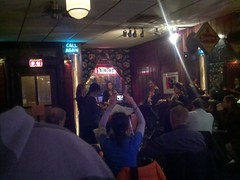
The opening stanzas from The Limousines' Internet Killed The Video Star played through my head and seemed apt given the classical music audience situation: "The kids are disco dancing/They're tired of rock and roll/I tried to tell them 'hey, that drum machine ain't got no soul/But they don't want to listen, no/They think they've heard it all/They trade their guitars in for drum machines and disco balls"

Absent said disco ball, the "Food" and "Liquor" neon signs in the windows, and the drop ceiling, I wondered if this might be considered continuing the tradition of the medieval tavern band.

Tonight the guitars, violins, cellos, harp, saw, turkey baster, and other assorted instruments peacefully existed with the disco ball, and there wasn't a drum machine to be seen; while a drum machine may have no soul the performances tonight were full of it. As the front door let occasional blast of late-fall air into the room, the warmth of the music was difficult to miss, as was the variety: Everything from standard string arrangements to a very large trio (I didn't count but I'd venture the trio numbered at least twice the usual number) using a upright bass as a percussion instrument and playing a combination of saw (with bow) and turkey baster.

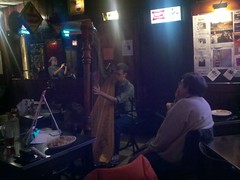
I honestly enjoyed all of the music that was brought before the audience tonight -- consisting of a mix of ClassicalRev regulars and disappointed Browns fans -- but was most interested by the sounds of Trepanning Trio's Balanise Love Song, and the novelty of the trio of harp solos. That's right, not only my first time hearing a live harp in solo form, but this was in a bar, only feet away from me--I can only imagine the logistical hurdles in moving such a large instrument from its home, up a few stairs and in and out of the bar--and it sound was beautifully resonant. Of course the string quintet that started the evening and the string quartet that I ended the evening with were beautiful (particularly the lively dance that I entered to).

(The quintet playing when I first arrived; the harpist playing feet from me; click either for larger version)
Classical Revolution Cleveland - November 2010Classical Revolution Cleveland - November 2010


Being in a bar, I ordered a delicious Strip Steak along with a couple adult beverages; the steak was good and it was interesting to hear the din of conversation mesh with the din of music: A conversation at the other end of the bar about the Cavs; another conversation when the game was over about the Browns loss; nearby there were discussions about music.

One of the occupants of a nearby bar stool is a member of the Detroit Symphony Orchestra, For those unaware of happenings outside the Cleveland bubble, let me restate that as "a member of the Detroit-Symphony-Orchestra-whos-musicians-are-currently-on-strike". I've been following the situation to the northwest with some curiosity since before the strike started*. The more I learn the less rational, logical, or even sane that orchestra's management strikes (pun not intended) me as--I'm offended by some of management's non-financial work rules proposals reported by the media, and I'm not even a stakeholder. My short conversation with this musician only bolstered my support for the musician's cause. (Cleveland's 1-day strike in January included concerns about a 5% cut in compensation for one year; Detroit is trying to push a 33%+ cash cut without full restoral**.)

So you never know what you're going to encounter at Classical Revolution -- and the variety is what makes it fun. I saw a saw played, I heard a harp mere feet from my ears

Lincoln
*- Though I've avoided writing anything since it's not a topic that I'm by any means qualified to write on -- I know none of that organization's history.
** - Based on the media reports I could find.