Showing posts with label Opera. Show all posts

Sunday, May 20, 2012

Cleveland Orchestra: Salome Opera-In-Concert

Richard Strauss: Salome (Based on the play by Oscar Wilde)
Franz Welser-Most, Conductor -- full cast list at the end of this

The Cleveland Orchestra is presenting its annual opera this year as an "opera in concert" breaking from the recent years "fully staged opera". Also a little different for this year the Orchestra is taking the opera on the road for two performances at New York's Carnegie Hall before returning to Cleveland with a final performance on Saturday, May 25th.

As opera in concert I wasn't sure what to expect, perhaps an "opera sized" orchestra with soloists on stage. Instead, The Cleveland Orchestra came out in full-force with a densely packed stage full of musicians and an usual platform for the singers projecting as a peninsula into the sea of musicians accessed by removing a section of the decorative organ pipes that typically grace the back of the Severance Hall stage.

This staging was visually satisfying -- in that it both elevated the majority of singers above the orchestra and lessened the gap between singer and surtitles -- but may have contributed to the one less than desirable  thing that both Rachel and I noted: The men's voices, particularly, tended to disappear in the musical expanse of the instruments--the "problem" didn't seem as pronounced with the women who typically clearly cut through.

The program note mentions that "Other observers were less concerned with the work’s alleged decadence or blasphemy than they were with the question: Is it an opera? Gabriel Faure was among the first, and certainly notthe last, to call Salome 'a symphonic poem with voices added.'" and certainly with this format it's easy to see how a listener would get that impression. And I rather liked it.

I typically have a hard time with fully staged opera because of how many moving parts are involved -- there's the set, the blocking (movements of singers and props), singing (along with reading surtitles if there's any hope to follow the plot), and music, and opera in concert really cuts to the core. You can listene to the singers and the orchestra while reading the surtitles and not have to worry about interpreting the set or the blocking or the costuming -- thus the closest I think I've come to truly following the story in an opera.

That said I was mostly there for the musical ride and Mr. Welser-Most certainly seems to be at home conducting opera. The opera runs just about an hour and a half of continuous music and is performed without intermission, but was never boring. The emotion -- which in many cases would be highlighted by blocking -- was clearly conveyed in the music.

The highlight of the evening for me, though, was Salome's Dance of the Seven Veils, though the story at the end of the opera kept me glued to the action.

Lincoln

The cast list:
Rudolf Schasching, tenor, Herod; Jane Henschel, mezzo-soprano, Herodias; Nina Stemme, soprano, Salome; Eric Owens, bass-beritone, Jochanaan; Garrett Sorenson, tenor, Narraboth; Jenniver Johnson Cano, mezzo-soprano, Herodia's Page and a Slave; Rodell Aure Rosel, tenor, First Jew; Matthew Plenk, tenor, Second Jew; Bryan Griffin, tenor, Third Jew, James Kryshak, tenor, Fourth Jew; Darren Stokes, bass-baritone, Fifth Jew and A Man from Cappadocia; Evan Boyer, bass, First Soldier and First Nazarene; Sam Handley, bass-baritone, Second Soldier; Brian Keith Johnson, baritone, Second Nazarene.

Saturday, March 19, 2011

Cleveland Orchestra: Don Giovanni (Fully Staged Opera)

I've said it before (and before and before) that opera isn't really an art form I connect with, I think the chief concern is that it's a bit of sensory overload -- I don't think I'd feel the same way about opera sung in English as opposed to the de regur Italian, but as no one seems to be doing that, at least in Cleveland, I can't say definitively.

That said you may be wondering why I plopped down $225 for something I don't really love...the short version is I bought it much by reflexive accident--not that I got dates mixed up or something like that, just that I've gotten in the habit of buying my next Cleveland Orchestra ticket before the preceding week's concert and I didn't think to check exactly what I was buying a ticket for until I had already mentally committed myself.

My only experience with Don Giovanni was Opera Cleveland's production of the same in late 2009..and it's funny, after I typed all of that to go back and read my thoughts from back then... because that post began eerily similarly.

Generally, The Cleveland Orchestra's production compares well -- the voices were wonderfully clear, the quality of the music was no less than I'd expect from the orchestra during any normal concert despite the condensed size and position in the makeshift pit in front of the stage. Singer and musician blended beautifully. On stage, the production benefited with a collaboration with Verb Ballets.

The production doesn't take itself too seriously (to wit, among others some decidedly not-1700s dance moves and a very interesting choice of weapon) but also avoids falling into the realm of slapstick. Also a notable plus to this performance -- though one shouldn't be surprised -- is that the musicians who appear on stage at a couple points during the performance are real musicians really playing real instruments. Though a small item, the use of fake instruments that weren't being played didn't sit well with me in the Opera Cleveland production.

Unfortunately, though in addition to my standard complaint about the surtitles board* the stage is more distracting and ineffective than anything else: A strong rake, angularly patterned floor, combined with legs and valences that have a bold wave effect lead me to give myself a little bit of a headache during the first few minutes trying to figure out if the rake was real or an optical illusion -- a question I returned to many times throughout the evening, and this added distraction didn't help my quest to follow the action or plot, let alone both. The first act was quite funny and well paced; the pacing of the second act, however, seemed to drag to the point where I was fighting a persistent yawn and becoming a bit fidgety, both most likely to the chagrin of the others in my box.

Catching me a bit off guard there are quite a large number of clothes being left on stage. Both male and female... who knew Mozart could be so racy?

Lastly, the program book must be mentioned. While The Cleveland Orchestra's program books usually contain a wealth of information on the weekend's concert to provide context, history, and background, the assemblage for Don Giovanni was amazingly comprehensive 29 pages covering synopsis, timelines, the librettist, the characters and real-life inspirations and not including singers biographies.

If you haven't tried opera before I'd encourage you to try it once -- and this is a pretty good way to try it. Additional performances on March 24th (Tuesday) and 27th (Sunday).

(Music: Wolfganga Amade Mozart; Libretto: Lorenzo Da Pointe; Conducted: Franz Welser-Most; Staged: Julia Mathes; Set: John S. Bukala; Lighting: Christopher Shick; Don Giovanni: Simon Keenlyside; Leporello: Ruben Drole; Donna Anna: Eva Mei; The Commendatore: Alfred Muff; Don Ottavio, Shawn Mathey; Donna Elvira: Malin Hartelius; Zerlina: Martina Jankova; Masetto: Reinhard Mayr; With the Cleveland Orchestra Opera Chorus and Verb Ballets.)

Lincoln
* To my "Sensory Overload" point: why does it seem to be opera's universal practice to place the surtitles that it is impossible visually track the singers and action while also following the plot? I eventually gave up on trying to follow the plot, which in all fairness could be part of the reason the second act seemed to drag (since I no longer had any clue what was going on).

Saturday, November 13, 2010

Opera Cleveland: La Voix Humaine & Pagliacci

A double-billing of La Voix Humaine (By Francis Poulenc, Libretto by Jean Cocteau) and Pagliacci (By Ruggero Leoncavallo) brought tonight's audience to PlayhouseSquare's State Theater for one of the last performances in Opera Cleveland's abbreviated season -- and one of the last in their current incarnation as Opera Cleveland.

To the outside observer, the writing has been on the wall in varying shades of darkness since before the season began. Opening the season with Lucia di Lammermoor -- I think my best opera-going experience to date (thanks in no small part to the semi-open rehearsal) both enthusiasm (audience and production) and and production quality were high. The intervening production of The Pearl Fishers was flat for enthusiasm but the production quality was still high. Tonight's operas, I hate to say, were flat for both.

Now most of the "production quality" issues that caught my eye (none caught my ear, thankfully) were minor in and of themselves but combined I got the sense of a struggle to get the show up--and surely no budgets were broken in the construction of the sets.

La Voix Humaine was agonizing. Consisting solely of the suicidal woman's side of a telephone conversation with a former lover, fighting through a party line, disconnected calls, and nosy neighbors. The concept is intriguing but the execution felt eternal; I didn't particularly care for the lone singer's voice. As much as I wanted to feel a sense of drama -- the woman was, after all, suicidal and speaking with a long-time lover on the eve of his wedding to another woman -- it could have been a reading of the daily news for all I could tell. The music, though well performed, was so punctuated--coming in short, seemingly unrelated bursts--that it didn't really add anything.

In Pagliacci, I realized (decided?) that even if Opera Cleveland emerges following the restructuring [and I sincerely hope it does], I will not be in that audience. As much as I want to like opera*, I realized that it's just not for me--and I can't justify the ticket prices for something that's I'm at best apathetic about. The opera opens with two mimes and beautiful music; I truly thought that I was going to enjoy it. Again, this struck me as emotionally flat, and all of the women's voices drove me crazy -- and I don't mean that in a good way. Thought the action on stage was unfufilling the music was beautiful and on more than one occasion dissuaded me from making a mid-opera exit; my favorite parts were all instrumental including a passage at the end that is instantly recognizable.

Lincoln

Wednesday, October 13, 2010

CIM Orchestra: Mozart/Walton/Wagner

Mozart: Overture to Die Zauberflote (The Magic Flute), K. 620
Walton: Concerto for Violin and Orchestra (Ai Nihira, violin)
Wagner: Symphonic Excepts from Der Ring des Nibelugen (Entrance of the Gods into Valhalla from Das Rheingold; Forest Murmurs from Siegfried; Siegfried's Death and Funeral Music from Gotterdammerung; Ride of the Valkyries from Die Walkure)
Asher Fisch, conductor.

During his opening remarks CIM President Joel Smirnoff commented on expanding the number of Severance Hall performances this year (I thought there were more of them!) and that it was particularly necessary based on the challenge of fitting so many instruments and so much volume in CIM's normal performance spaces.

Admitting that I was a bit skeptical of that comment through the first two pieces on the program, the excerpts from The Ring Cycle absolutely proved the point.

The Magic Flute is a piece that seems to be orbiting just outside of my reach -- it seems that I've heard of more performances of this piece in the last six months than any other piece -- yet I have not actually heard this piece. Though it's has a slow start, it got moving to a quite pleasing clip by midpoint.

Walton's Concerto for Violin and Orchestra left me unsatisfied -- perhaps it was too introspective during a time when I'm asking myself too many questions -- but the je ne sais quois that I crave didn't hit me. There were certainly passages that were pleasant to listen to sprinkled throughout the work but they were not the majority.

After intermission and rounding out out the program were five excerpts from Wagner's Der Ring des Nibelungen (also known as The Ring Cycle). Every time The Ring Cycle comes up I'm reminded by a comment one Cleveland Orchestra guest conductor made from the podium -- that The Ring Cycle, depending upon the age and weight of the conductor, can take between 24 and 30 hours to perform in its entirety. I don't know if that's true, but nonetheless, the cycle is a substantial body of work. It's also worth noting that four harps were present on stage for this work.

Mr. Fisch's comments before the work reinforced that, highlighted the difficulty of excerpting coherent pieces from the wholes, and made no apologies for the fact that the music that was presented tonight was not precisely as it would have been heard in the operas. That didn't diminish the quality in the slightest. From the energy of Entrance of the Gods into Valhalla to the delightfully textured and restrained Forest Murmurs (Where a flute clearly evoked the feelings of birds on a soft landscape laid by the strings).

Siegfried's Rhine Journey began beautifully in the cellos (what can I say, I'm a sucker for strings -- especially the cello) and grew from those relatively small beginnings into something big. The Death and Funeral March took that big, punctuated it with horns and oh, my. "Explosive" was the first word that came to mind to describe the impressive energy emanating from the Severance stage... but Explosive has the connotation of being uncontrolled. This was anything but uncontrolled.

The concert ended with the well-known Ride of the Valkyries. It was good. There's not really anything to say on that subject.

I should also note that Mr. Fisch conducted the Der Ring des Nibelungen pieces (and perhaps the others as well -- I didn't happen to notice) without benefit of a score. That impressed me.

Lincoln

Tuesday, September 28, 2010

Anyone Claiming "There's Nothing to Do In Cleveland"

As a non-native -- someone who doesn't instinctively respond "I!O!" when prompted by a stranger screaming "O!H!" -- people often ask why I say I love Cleveland, not infrequently adding "There's nothing to do here".

This reaction has tempted me, on more than one occassion, to kidnap a person to show them Cleveland through an outsider's eyes. That probably wouldn't end well. But the thought has crossed my mind.

I bring your attention to the past 9 days, wherein I personally...
Attended one visual arts event. Cruised the museum of art solo, twice. Saw two plays: One hysterically funny, one left me feeling as if I was a hostage to boredome. Attended two faculty recitals of chamber music. Heard the concert that opened the Orchestra's 2010-11 season. Saw a comedy show. Saw and heard an opera. Mingled during two happy hours. Met a new friend for wine. Had a violin lesson. Attended a rehersal that was amazing. Got a couple 10 mile walks in.

That's right...15 events in 9 days...and there are at least two that I was interested in that I didn't make it to for one reason or another. And yet, "Why would you move here? There's nothing to do in Cleveland!".

Disappointing, of course, that I didn't meet any singles "my age" during any of those events, but there are certainly things to do in Cleveland. And I'm just an "artsy guy" -- if you add sporting events to that list, you get well...a nearly endless variety.

Particularly worth noting is that more than half of those events were free; all but two under $50...(And I think there are options for both of those that would get them at or under $50 in the right circumstances).

Why I love living in Cleveland...

Lincoln
(Presently in Columbus for work.)

Saturday, September 25, 2010

Opera Cleveland: Bizet's The Pearl Fishers

Before this evening's opera, I attended a Happy Hour at the House of Blues Cleveland's Foundation Room -- while relatively short--at just over a true clock hour--it was another interesting event with good conversation. The host for the event mentioned walking, and leaving HOB I realized that I would have both felt more comfortable about drinking (limiting myself to one glass of white) and saved $5 on parking at East 4th if I had parked in Playhouse Square's garage and walked to/from the HOB... anyway...

After relocating my car I downed a cupcake in the State Theatre's lobby (Cursing fate: The one time I was really craving a pretzel for 'dinner' they were not to be found) and entered for Opera Cleveland's presentation of Georges Bizet's The Pearl Fishers.

I've said before that Opera is an art form that challenges me. Tonight I must admit defeat in response to its challenge. The music was beautifully played, the libretto beautifully sung, and the set was a a fantastic blend of minimal but eye catching physical props with tastefully (not over) done multimedia. The show received one of the more enthusiastic applauses I can recall from an operatic performance.

But it wasn't for me. Perhaps the length -- the program lists the running time as 2:30 including two 2o-minute intermissions: If that was accurate and allowing for the customary 5-minute hold, the 3rd act would have been approximately 10 minutes. It was not. Perhaps the foreign language: Again, the placement of the surtitles in relation to the set makes it impossible to follow both action and plot at the same time-- even reading the synopsis, I'm not entirely sure what I saw, heard, and listened to so beautifully.

But whatever it was I found myself entirely unmoved: Though I stayed through the curtain call, I felt no compulsion to linger.

In the vein of "history is taught in a vacuum" seeing the premiere date -- September 30, 1863 -- perhaps in conjunction with the trivia note in the program that John Wilkes Booth's appeared in a Cleveland venue just prior to the assassination of my namesake was in Cleveland -- fell in the middle of the American Civil War. Not that that's of iny significance, it's just an interesting point to ponder.

Lincoln

Sunday, May 16, 2010

Opera Cleveland: Opera Sampler - Lucia Di Lammermoor

I'm a sucker for anything that gives a glimpse into the creative process--or offers free food, so when Opera Cleveland's "Opera Sampler" invitation arrived in my inbox it didn't take more than a few seconds to sign up.

The agenda for the evening, hosted by Opera Cleveland Marketing Director Paul Jarrett was simple yet effective: Talk, listen, tour, eat. And if you read no further, I have to say that the rehearsal I heard of Lucia's Act I this evening was one of the more compelling pieces of opera I've heard. You have one weekend -- Thursday, Saturday, and Sunday next week to catch the performance: With a early dress rehearsal that was this well played and sung I'm eagerly looking forward to hearing the full opera next Saturday... When evaluating that sentiment, consider that I've had very mixed feelings about opera.

The evening began with an introduction by Artistic Director and conductor Dean Williamson: Each time I've had the pleasure of hearing him speak on an opera, the piece gains an amazing clarity and it is clear that he understands the material. I found the set conception -- recycled pieces from another opera company's set, combined with both front an rear video production intriguing, as well as the "slightly modernizing" aspect of pushing the setting into the 1930s mobster era to add realatability. Generally interesting were Mr. Williamson's comments on the acoustics of Playhouse Square's State Theatre; and his casual yet confident demeanor really helps to take the "stuffy" edge off Opera.

That segued into an early dress rehearsal of Act I which was beautifully sung, and beautifully played. I took the invitation to move around to heart using the opportunity to both see and hear the opera from literally every corner of the theater: Aside from the loge I lucked into for Solome, I've never really found a seat that I loved for opera--the floor-level side boxes are lousy, and the front few rows of the orchestra (my normal preference for anything but opera) leave a bit to be desired if you're trying to watch the action and read the surtitles at the same time. Based on my informal survey, I think those may be only really bad seats. Sure, the loges are supreme, but the first few rows of the balcony (where my subscription seats are this year) are good offering a full view of the stage, good view of the surtitles, and an amazingly clear and well balanced auditory experience. Even at the back row of the upper balcony or orchestra, it sounds great and the surtitles are legible, though you may wish to take opera glasses if facial expressions are important.

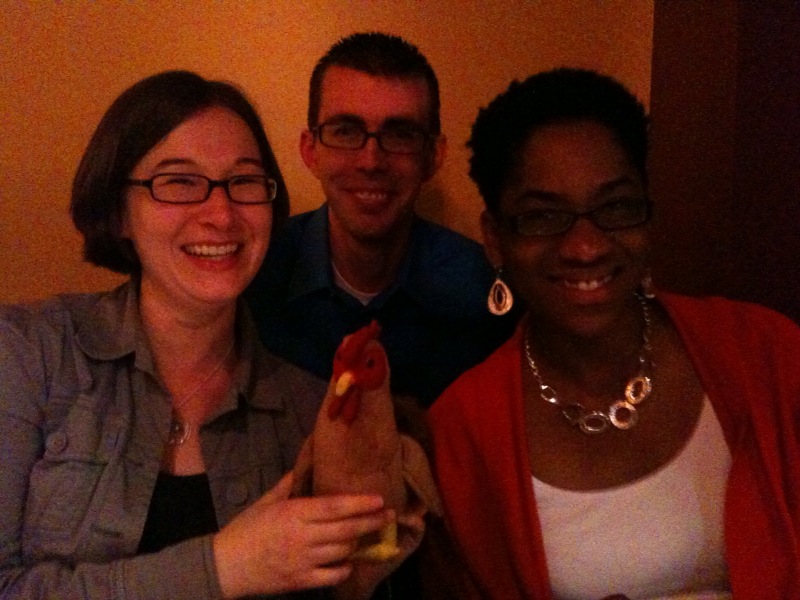
Things wrapped up with a quick backstage tour including a brief appearance by Opera Cleveland's technical director -- who I could have smothered with questions if time allowed -- before winding up across the street at Bricco with free pizza and no-so-free drinks (Ok, seriously, the martini that goes by the name "Apple" is probably the among the best drinks I've had in years) with very casual socializing -- including bumping into two people I recognized from other cultural events). I even met Carl the Opera Chicken, a photo may be (crosses fingers) surfacing soon can be found below.

Did you know that a chicken has been hidden in every Opera Cleveland production?

It was a great event and I hope it will be offered again; certainly a good way to dip your feet into the opera experience.

Lincoln

Wednesday, February 24, 2010

CIM: Opera Theater: Ariadne aud Naxos (Strauss)

A question for anyone involved in the production/design end of opera: Why do you insist on hanging surtitles at such unreasonable heights? (go ahead and post a comment or email me directly at l at lincolnincleveland.com)

Particularly in the case of Cleveland Institute of Music's Kulas Hall where there is only one seating level with a relatively shallow pitch I can figure no reason -- other than the desire to inflict a literal pain in the neck -- why the tallest singer was roughly 6' yet the surtitles were displayed at about 24'. This extra 18' of empty space made it impossible to watch the singer's body language and follow the story simultaneously. The set was visually interesting.

I've said it before, and I'll say it again: I'm not particularly well qualified to judge opera based on my relative lack of exposure. The following observations are those of a lay person in the truest sense.

Generally, I thought the first act was uneven, particularly as far as the female singers were concerned. The second act was more even, but felt interminable as far as pacing was concerned. One singer in particular made what I felt was a weak entrance in the first act but, on sum, possibly delivered the most impressive individual performance. Given the fact that these are college students the individual performances were quite impressive.

The music was generally well played, but nothing really caught my ear aside from the overture and entr'acte...most of my attention was spent ping-ponging between the surtitles and action on stage.

Total running time, approximately 2:45 including intermission.

Lincoln

Saturday, January 30, 2010

New York: Day 4, Part 2: Chicago Symphony Orchestra - Carnegie Hall

Ravel: Le Trombeau de Couperin (1914)

Dalbavie: Flute Concerto (2006)Bartok: Bluebird's Castle, Op. 11
Pierre Boulez, conductor.

On my way to Carnegie Hall I spotted the creation you see on your to the right from across the Q express tracks at Times Square/42nd St. station (the uncropped version can be found at Flickr for the full context)... perhaps I've been spending too much time looking at Contemporary Art or perhaps it's a testament to the quantity of public art throughout the MTA system but my first take was to try and figure out the artist's intent... first guess was a figure lounging while reading a book, then a reclining figure playing a bowed instrument of some kind with the music in front of him... and when I finally realized it was graffiti I had to take a picture.

Until this evening the Cleveland Orchestra was truly the only orchestra I had heard*. Upon learning that, a talented young violinist I met through Match.com told me that I would be disappointed with anyone else I would hear. During the preshow lecture, I noticed the Stern Auditorium/Perelman Stage seemed particularly acoustically live and boomy as compared to Severance Hall, which, in retrospect is fairly dead acoustically**. My seat was not in the best location, visually or acoustically, but it was serviceable.

I was not disappointed -- the concert was thoroughly enjoyable, but I felt like something was missing. There is something intangible, indescribable, a...je ne sais qouis that makes listening to the Cleveland Orchestra -- at Severance or Blossom completely different than what I listened to tonight. Near the end of the Bartok piece I realized that when I'm listening to TCO I feel like I'm listening to an integrated whole that envelops me in the music. Tonight, on the other hand, I felt detached and it almost seemed as if every section existed in it's own universe that while contributing to the whole ignored the constituent parts. It's hard for me to come up for a good description for what I felt.

There were a few moments, particularly in the Ravel and Bartok pieces where the reverberant nature of the hall was instantaneously distracting -- I'd hear a note from a flute or a horn and milliseconds later hear that same note from "behind" me.

It was interesting to watch Mr. Boulez conduct; of all of the conductors I've observed I think he was the most understated, rarely moving his hands more than a few inches, never moving on the podium, and every movement was fluid; I didn't notice a single sharp/aggressive gesture..

I think Ravel's Le Tombeau de Couperin was my favorite from the evening, particularly the first and fourth movements (Prelude and Rigaudon). Dalbavie was in attendance for the performance of his Flute Concerto which was not bad, though I didn't particularly take anything away from it.

I turns out that despite my giving the Metropolitan Opera a pass, I was still destined to hear opera while I was in New York City. While Bartok's Bluebeard's Castle will not ascend my favorite's list, The piece had several interesting moments and the performance benefited from several features that made it immensely more enjoyable:
  • The use of an electronic display for surtitles, and that display was at a reasonable height above the orchestra (perhaps 15' above the stage), allowing both the orchestra and the titles to be in view at the the same time. One of my chief complaints with Opera Cleveland is that they position the title board at the top of the proscenium arch, making it impossible to both watch the action on stage and follow the story at the same time.
  • A printed text and translation for the entire opera in both Hungarian and English. While I primarily used the surtitles, this booklet made it easier to gauge the progress of the work and review any dialog I missed.
  • The singers were not amplified, and mixed well with the orchestra. I could easily "tune out" either group depending on my listening preference at any given moment.

Finally, I thought it was interesting how many times the words "Cleveland Orchestra" appeared in the program: The schedule insert for the 'Great American Orchestras I' series (February 5, 2011); Mr. Dalbavie's biography [page 33]; Mr. Boulez's biography [Page 38i]; Mr. Aimard's biography [Page 38j]; and Ms. DeYoung's biography [Page 38m]

Lincoln

*- I don't consider the two "pops" orchestras I've heard (Long Beach and Cleveland Pops) or student orchestras (the Cleveland Institute of Music) in the same orbit

Friday, January 29, 2010

New York: Day 3, Part 1: Ce n'est pas un blog.

So I looked at getting tickets for The Metropolitan Opera either tonight or tomorrow afternoon's matinee. I decided against it because... well... I have psychological issues that prevent me spending $375 on a single seat for a single event. (Not to mention that while I'd love to try out "Met Titles", I'm not that big of a foreign-language opera fan).

Anyway... the morning started with me trying to visit The High Line, a former elevated railway downtown that's been converted to park space. I've read about it and seen it on TV so I figured I'd check it out in person. It happens to be very easy to find but impossible to find access to, though with the firigid temperatures -- I lost feeling in my ears. I didn't know you had feeling in your ears. -- I wasn't exactly motivated to spend a lot of time outdoors. After buying the most god-awful looking cap-thingy to help keep my ears a little bit warmer, I took a somewhat circuitous route to

The TDF/TKTS booth at South St. Seaport, that involved going back uptown to Grand Central then downtown... largely so I could warm up a bit. Thanks to a wrong turn, I wound up at the World Trade Center site before finding the TKTS booth where I got a ticket for tonight's performance of Next To Normal... read more about that in Part 2. You know the whole ticket-handling-fee racket is getting out of control when your receipt actually lists a "Fee Fee" of $2.50...

That business taken care of I headed for The Museum of Modern Art. While I found relatively little that truly caught my eye at The Metropolitan Museum of Art yesterday, there was comparatively little that didn't catch my eye at MoMA, though I will admit that my fascination was directed more at the photos, lithios, and 3D objects than paintings.

Last but not least for Part 1 I wound up at The Guggenheim Museum. I knew that I was in for a museum unlike any other when immediately after (not-)paying I walked into a very passionate/sensual peice of performance art between a man and woman (fully clothed, however). The true suprise was yet to come.

You often hear about art "challenging" you or "engaging" you, but I've never come upon such a literal challenge. It turns out that today was the opening for Tino Seghal's This Progress, an artist and installation I had never heard of. Upon walking up the Gugenheim's famous ramp, I was met by an attractive young woman who invited me to observe a piece of performance art. She asked the meaning of progress, and while we walked up the ramp challenged me to define it and relate it, expand it. (This is precisely the kind of conversation that I'd love to have over dinner and why being single is slowly killing me). She then handed me off to a gentleman and the process repeated, more or less, as it did two or three more times until reaching the top of the ramp. (Seriously, everything outside of the conversations disappeared into a blur, I was simultaneously trying to carry on a conversation while trying to process what I was experiencing.

After arriving at the top of the ramp the last person and I parted ways and I was left to look at the traditional art on display, of which there is not much at the moment--what is on the walls is fantastic to look at, but there simply isn't much gallery space open at the moment. Mr. Seghal's "piece"? "installation"? "exhibit"? Made the visit very well worthwhile.

It can be, and has been, said that everyone experiences art in their own way... With this piece that could never be truer. A much more comprehensive writeup can be found at The New York Times: http://www.nytimes.com/2010/01/17/magazine/17seghal-t.html

Lincoln
(It's funny to note that I had chosen the "Ce n'est pas un blog" title on my way back to the hotel and before I stumbled across this article in the New York Observer titled "Ceci n'est pas Performance Art"... I guess I wasn't the only one who had that reaction to interacting with the piece.)

Saturday, October 31, 2009

Opera Cleveland: Don Giovanni

One of the funniest things I've seen all year; great music, too.

I don't really get opera sung in Italian -- opera in English is no problem, but I tend to suffer from a case of Sensory Overload with Italian opera. There are so many facets happening simultaneously -- the singing, the music, the surtitles, the scenery and blocking, etc. It's an art form that I'm not really sure how one is supposed to appreciate.

Usually my mind dwells on one of those aspects just long enough that I forget to keep an eye on the super titles and by the time I start paying attention again I am destined to remain lost as to what, exactly, is going on. This was true with last night's performance of Don Giovanni -- but there were enough one-liners that didn't require extensive context that I remained amused. How could you not like Leporello?

I can't say what my specific thoughts were on Mozart going in to this performance, but I have to say that they changed coming out--not so much for the quality or style of music, but I he no longer seems as stiff -- between the self-referential comment about hearing The Marriage of Figaro too often and lines "I will comfort her tears / (Along with 1800 of her peers)" -- makes the 1700s seem so much less oppressive.

I do wish that Opera Cleveland would fly in the board that the surtitles are projected in another 10 feet or so... the distance between the singers and the surtitles is such that it's nearly impossible to keep both in your field of view at the same time, which I think would help in terms of following the story.